


By 2020, my hair was changing.
Not dramatically.
No movie scene.
No handfuls of hair in the sink.
Just the slow retreat.
A little thinner.
A little further back.
The sort of thing you notice under bright bathroom lights and then pretend you haven’t.
I had spent years making professional hair products.
Now I had a problem of my own.
I didn’t simply want hold.
I wanted thickness.
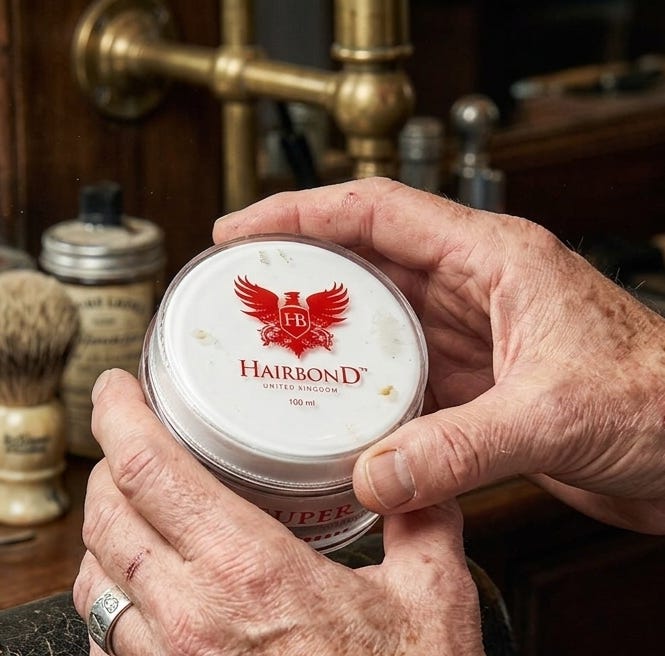
That became Hairbond Super Fibre.
It took nearly two years to get right.
Fine Hair Has Different Rules
When hair starts thinning or receding, the natural instinct is to throw more product at it.
Usually a mistake.
Too much heavy wax can separate the hair.
Too much shine can make the scalp more obvious.
Too much product can flatten everything you were trying to make look thicker.
You end up with less hair looking like even less hair.
Not ideal.
I wanted something different.
Texture.
Density.
Control.
But without plastering the hair down.
Something that allowed me to build shape and make the hair feel fuller while still looking natural.
And if I was going to put the Hairbond name on it, I wasn’t going to cheapen the formulation to hit a target cost.
My instruction was simple.
No expense spared.
So We Brought in a Specialist
I knew what I wanted the product to do.
Knowing what you want and knowing how to formulate it are two different things.
So we brought in a specialist hair-product chemist to work with us on the development.
That mattered.
This wasn’t me standing in a kitchen throwing ingredients into a bowl and hoping for the best.
We had professional formulation expertise behind it.
I could explain the problem from the chair and from my own experience.
The chemist could translate that into formulation.
Then we tested it.
And tested it again.
Changed things.
Rejected things.
Made another sample.
Tried that.
Changed it again.
Nearly two years of development.
For a tub of hair product.
Excessive?
Possibly.
But I was going to use it myself.
That makes you a particularly awkward customer.
The Brief Wasn’t Easy
I wanted Super to be water-based.
I wanted it formulated without parabens or sulphates.
I wanted keratin incorporated into the formulation.
But ingredients on the back of a tub are useless if the thing doesn’t perform.
So there was another list.
Texture.
Thickness.
Control.
Workability.
A natural-looking finish.
And enough structure to help finer hair without making it heavy, greasy or rigid.
Hair still had to look like hair.
A surprisingly difficult brief.
It Had Another Job
There was another reason Super mattered.
Hairbond had two products our customers knew extremely well.
Moulder.
Mattifier.
Two of our best sellers.
Both had to be discontinued.
That left us with a choice.
We could try to make copies.
Something roughly similar.
Change the packaging.
Call them new.
Move on.
I didn’t want that.
If two successful Hairbond products were disappearing, what followed had to justify the disruption.
Super couldn’t simply fill an empty space.
It had to move Hairbond forward.
We had years of experience from Moulder and Mattifier.
We had professional feedback.
We had my increasingly uncooperative hairline.
And now we had specialist chemistry behind the development.
Put it together.
Make something better.
That was the job.
Why Fibre?
The clue is in the name.
Super Fibre.
The objective was substance.
When your hair is finer or receding, you’re often trying to create the appearance of more structure without loading the hair with more weight.
That balance matters.
Too little and nothing happens.
Too much and the hair separates, collapses and starts advertising precisely what you were trying not to advertise.
Super was designed to sit in that middle ground.
Build texture.
Create shape.
Add control.
Keep movement.
Use what you’ve got.
Make it work harder.
How I Use It
Technique matters.
Especially with finer hair.
Don’t scoop half the tub out.
You aren’t rendering a wall.
Start small.
Work the product properly through your hands.
Build your shape first.
Then work Super through the hair to reinforce it.
If you need more, add more.
You can always put another little bit in.
Taking half a tub back out is considerably harder.
For me, the objective has always been thickness, texture and controlled movement.
That’s what I wanted when we started developing it.
It’s still what I want now.
I Was the Customer
Companies like phrases such as:
consumer-led innovation.
Very impressive.
Usually followed by a graph.
Super was simpler.
I looked in the mirror.
My hair was receding.
I wanted it to look thicker.
Despite owning a professional hair brand, I couldn’t quite find the product I wanted.
So we decided to make it.
Then we brought in a specialist hair-product chemist and spent nearly two years getting it right.
That is the bit consumers rarely see.
The samples that aren’t good enough.
The formulation that gets close but not close enough.
The changes that sound tiny but alter how a product feels in the hands or works through the hair.
The temptation to say:
That’ll do.
Those might be the three most expensive words in branding.
Because eventually the customer finds out.
Products Have to Earn Their Place
Hairbond products have always had personalities.
Moulder had one.
Mattifier had one.
Distorter has one.
Shaper has one.
Super needed its own reason for existing.
Not another fragrance.
Not another colour.
Not another SKU because someone found an empty box in a range plan.
A real problem.
A real brief.
Professional formulation.
Two years of development.
Then a product.
That’s enough.
The Bloke in the Mirror
Hair changes.
Trends change.
Customers change.
Eventually your own hair joins in.
You can complain.
Or you can make something.
I chose the latter.
Hairbond Super Fibre started with my receding hairline.
Then we brought in specialist chemistry.
We spent nearly two years developing it.
The brief was uncompromising.
No expense spared.
Water-based.
No parabens.
No sulphates.
Keratin added.
And enough performance to take the place of two of Hairbond’s best-selling products.
That’s a lot to ask from one tub.
Good.
Products should have difficult briefs.
Otherwise what’s the point?
My hair was getting thinner.
I wanted thickness.
So we made Super.
Sometimes your best product-development meeting starts with the bloke in the mirror.
The important bit is knowing when to bring in someone who understands the science.