


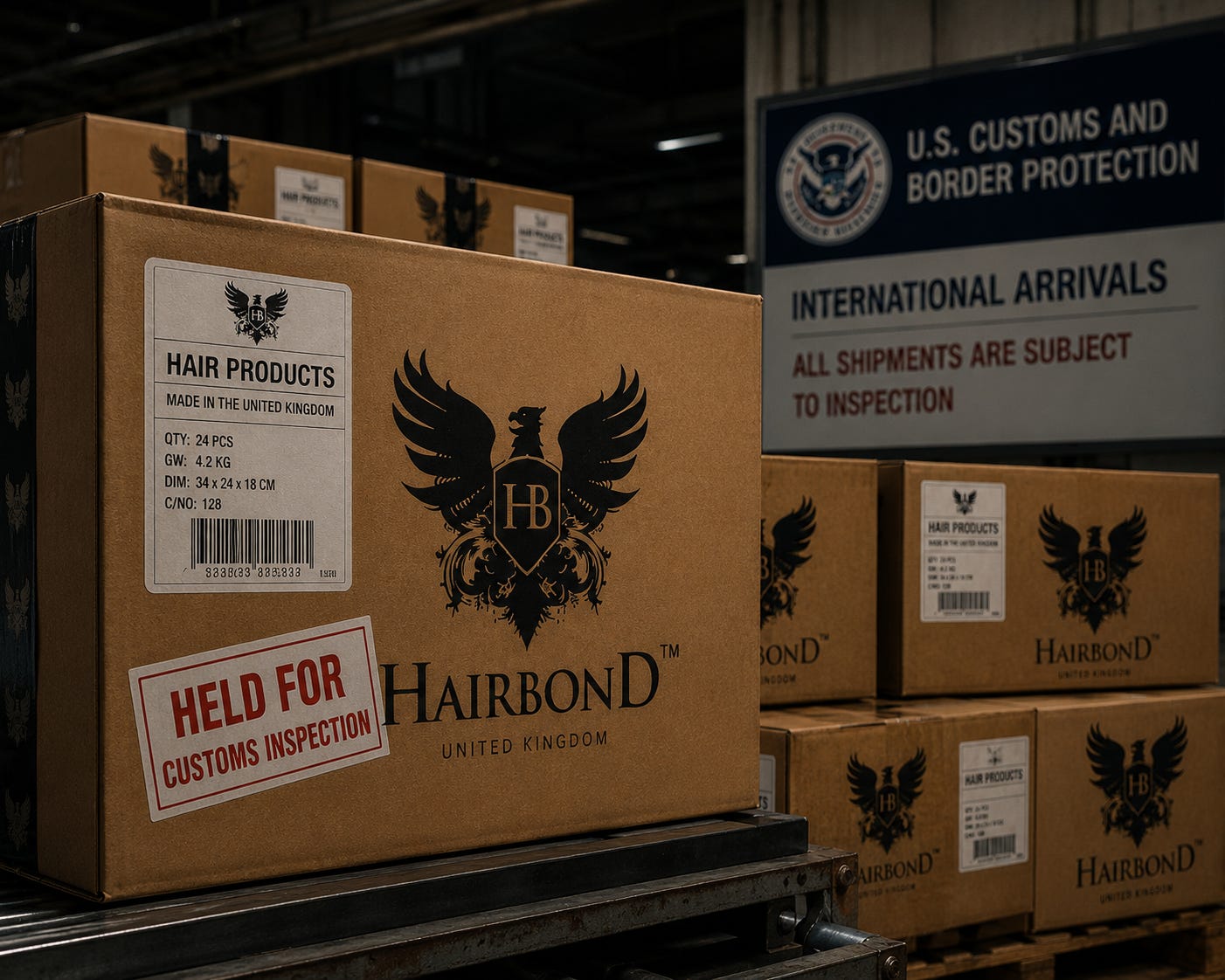
Hairbond has spent years building relationships across the United States.
We have supplied American barbershops, salons, retailers, footballers, wrestlers, actors and film productions.
We built that business one relationship at a time.
One barber.
One retailer.
One recommendation.
A shop could order a few boxes, test the products and grow with us.
It was not always easy.
But it worked.
That route is now becoming commercially impossible.
Not because Americans have stopped wanting British products.
Because tariffs, customs charges and carrier fees have made small shipments expensive, unpredictable and difficult to explain.
The customer sees Hairbond’s name
A customer places an order.
They pay for the products.
They pay for international delivery.
Then the parcel reaches America and another payment may be demanded before it is released.
The bill may include tariffs, customs charges and courier handling fees.
Hairbond did not create that charge.
But our name is on the parcel.
So our inbox receives the complaint.
The American importer pays first.
The retailer and customer feel the cost next.
Then the British brand manages the damage.
That is how tariffs work in the real world.
One failed order can wipe out several successful ones
The headline tariff is only the beginning.
There is the cost of manufacturing the products.
Packaging them.
Picking the order.
Shipping it across the Atlantic.
Preparing customs information.
Paying carrier fees.
Answering customer messages.
And sometimes paying for the parcel to return to Britain.
The maths on a failed order can look like this:
A retailer places a £300 order.
International delivery costs £45.
An unexpected charge appears when the parcel reaches America.
The customer refuses it.
Hairbond refunds £345 to protect the relationship.
The original postage is gone.
The return can take weeks.
The products may arrive damaged.
Sometimes they do not arrive back at all.
The government keeps its charge.
The courier keeps its fee.
The small brand keeps the problem.
One failed parcel will not destroy a company.
Years of failed deliveries, refunds, disputes and missing returns can cost tens of thousands of pounds.
That is what has happened to Hairbond.
Small businesses are being asked to behave like corporations
The removal of America’s low-value import exemption made the problem worse.
The old system allowed an independent barber or retailer to try a British brand without importing a pallet.
Small businesses could start small.
Now even modest commercial shipments can face tariffs, customs processing and additional fees.
A multinational can adapt.
It can import containers.
Employ customs specialists.
Rent American warehouses.
Negotiate cheaper freight.
Spread the cost across millions of products.
An independent barber ordering a few boxes cannot.
Neither can every British manufacturer.
The smallest businesses are being asked to operate like corporations before they have been given the chance to grow.
Hairbond cannot control every part of the journey
International delivery involves several organisations.
A British carrier handles the parcel here.
A postal partner or private courier handles it in America.
US customs controls entry.
Another company may collect the charge.
Each organisation controls one part of the journey.
The customer expects Hairbond to control all of it.
We do not.
Tracking stops.
A parcel is held.
A charge appears.
The customer refuses to pay.
The box begins its slow journey back to Britain.
Somewhere in the middle sits a jar of hair product, apparently applying for permanent residency.
Customers do not want a customs seminar.
They want three things:
Click.
Pay.
Receive.
When that simple promise breaks, the brand takes the blame.
This does not protect the American barber
An American barbershop selling Hairbond does not take work away from an American barber.
It helps that barber earn more.
The barber uses the product to finish the haircut.
The shop sells it to the customer.
The retailer earns a margin.
The customer receives more choice.
That economic activity happens in America.
The current system makes it harder.
The barber pays more for stock.
The retailer loses margin.
The customer faces a higher price.
The British brand may lose the sale.
The government collects the charge.
It is difficult to see how the independent American business wins.
America First should not mean independent American businesses last.
Trump changed the economics
Donald Trump argues that tariffs make foreign countries pay.
That is a good political slogan.
It is not an accurate description of what happens at the customer’s door.
The American importer pays the tariff.
That cost then moves through the supply chain.
The retailer absorbs part of it.
The customer pays more.
The foreign producer may cut its margin, refund the order or abandon the market.
Everyone becomes poorer except the system collecting the fee.
This is not an attack on American people.
American barbers, retailers and customers have supported Hairbond for years.
Our frustration is with the system around them.
America remains a great market.
It is no longer an easy market for an independent British exporter.
The answer is American distribution
Complaining will not solve the problem.
Hairbond must build around it.
Sending small wholesale orders from Britain to individual American barbershops is no longer the right long-term model.
The shipping is too expensive.
The customs process is too uncertain.
The risk of surprise charges is too high.
The cost of failed orders is too damaging.
The answer is to import larger quantities and hold Hairbond stock inside the United States.
American barbershops and retailers can then order domestically.
That means:
Faster delivery.
Lower shipping costs per unit.
Fewer customs delays.
No surprise import bill on every shop order.
More predictable pricing.
Better availability.
Easier returns.
The tariff does not disappear.
But freight, customs and handling costs can be spread across far more products.
Instead of every American barber becoming an accidental importer, one experienced partner handles the process properly.
We are looking for serious American partners
Hairbond is actively looking for established American distributors, wholesalers and professional retail groups.
We do not need another passive listing on a website containing 30,000 forgotten products.
We need partners that can build.
The right partner will:
Understand professional barbering, salons and men’s hair.
Have existing relationships with American retailers.
Be able to import and store cosmetic products properly.
Maintain stock.
Open new accounts.
Educate retailers.
And treat Hairbond as a brand to develop, not another barcode collecting dust.
Hairbond brings nearly two decades of history.
British manufacturing.
Professional products.
Distinctive packaging.
Recognisable fragrances.
Football and entertainment heritage.
A loyal customer base.
And a voice that was not created during a meeting about brand tone.
We have not given up on America
The easiest response would be to walk away.
We will not.
We know American barbers like Hairbond.
We know American customers value British-made products.
We know the demand exists.
But we will not pretend the old route still works.
The rules changed.
So the model must change with them.
We will hold products closer to the barbers who want them.
We will reduce the distance between the brand and the customer.
We will remove surprise import charges from individual wholesale orders.
And we will find partners capable of opening doors rather than merely standing beside them.
Trump may have made the old route harder.
He has not removed the destination.
America once rewarded small businesses willing to take a chance on each other.
We still believe it can.
Until then, Hairbond will keep finding another way in.
Established US distributors, wholesalers and professional retail groups interested in representing Hairbond should contact us through Hairbond.com or Partners.Hairbond.com.