


In ten years, people will still sit in a chair and trust another person with their appearance.
That will matter more than ever.
Hairdressing will survive because it offers something technology cannot replace.
Human contact.
One person listens. One person creates. Both look in the mirror.
The haircut is only part of it.
For many people, the salon or barbershop is where somebody remembers their name. Where they talk. Where they feel noticed. Where they leave feeling better than when they arrived.
As more of life moves behind screens, that connection will become more valuable.
People will not stop paying for haircuts.
They will pay more for good ones.
The middle will disappear
The industry will split.
At one end will be fast, cheap cutting.
At the other will be skilled professionals with a reputation.
The middle will struggle.
A hairdresser offering the same service, finish and experience as everybody else will find it harder to justify the price.
A great hairdresser will not.
Customers will spend more on fewer, better appointments. They will travel further for the right person. Skill will matter more than convenience.
The best professionals will become known for something.
Cutting. Colour. Curls. Texture. Transformations. Modern men’s hair.
They will not try to be everything to everybody.
They will become artists with a speciality.
That is where the money will go.
Hairdressers are artists, not factory workers
More regulation will come.
Some of it will be needed.
There should be proper standards around chemicals, hygiene, safety and training. Customers deserve protection. Good professionals should not have to compete with dangerous practice.
But regulation can go too far.
Hairdressers should not need the paperwork of a haulage company to cut a fringe. They should not need the equivalent of an HGV licence to mix colour or rent a chair.
The danger is simple.
People who do not understand the trade will try to control it.
They will create forms, fees, courses and certificates.
Then another certificate to prove the first one was completed correctly.
Before long, the professional spends more time proving they can work than doing the work.
The future needs better standards.
It does not need a bureaucratic cage.
Regulation should remove danger.
It should not remove independence, creativity or opportunity.
Hairdressers are artists.
Treat them like professionals.
Do not turn them into factory workers.
The old salon model will shrink
Large salons with big payrolls will become harder to run.
Costs will rise. Employment will become more complicated. More professionals will rent chairs, share studios or work from smaller appointment-only spaces.
That creates freedom.
It also creates a problem.
Who trains the next generation?
Hairdressing is not learned through a screen.
It is learned by watching. Sweeping floors. Making mistakes. Listening to clients. Seeing how experienced professionals solve problems.
The trade cannot survive on finished professionals alone.
It needs places where young people can become professionals.
Independence is good.
An industry without apprentices is not.
Technology will assist the artist
Artificial intelligence will run more of the business behind the chair.
It will answer messages, fill cancellations, remember formulas, manage stock and create marketing. It may even show customers possible styles before the first cut is made.
That will save time.
Good.
Hairdressers should spend less time on administration.
But technology must remain the assistant.
Not the artist.
A machine can create an image of a haircut.
It cannot feel the weight of the hair.
It cannot read doubt in a customer’s face.
It cannot judge how a style will behave after three days of rain.
It cannot understand that “do whatever you think” rarely means do whatever you think.
That judgement is human.
It will become more valuable.
The consultation will become part of the service
The days of asking “same again?” will fade.
Customers will expect advice.
They will expect a professional to understand their face, hair, lifestyle and confidence.
The best hairdressers will tell the truth.
That cut will not suit you.
That colour will damage your hair.
That style will take twenty minutes every morning.
This one will work better.
That honesty will be worth money.
The consultation will no longer be small talk before the real work.
It will be part of the real work.
The future salon must go premium
Salons and barbershops cannot keep absorbing higher costs while charging yesterday’s prices.
Something has to change.
The answer is not to work faster.
It is to become better.
Invest in the shop.
Improve the lighting. Replace the tired chairs. Clean up the reception area. Upgrade the consultation. Train the team. Improve the music. Serve better coffee.
Make the retail shelf look like it belongs there.
Premium does not mean gold taps and marble floors.
It means care.
Detail.
Consistency.
It means the customer can feel the difference before the scissors touch their hair.
The businesses that survive will charge more.
They will have to.
But customers will pay more when the experience justifies it.
A cheap haircut invites a price comparison.
A premium experience creates loyalty.
The race to the bottom has never produced a better industry.
It has produced tired professionals, neglected shops and customers trained to believe skill should be cheap.
The next ten years must move in the opposite direction.
Better shops.
Better service.
Better products.
Better prices.
Weak products will die
The product market will become harder.
That is good.
Too many products have survived through marketing, distribution and noise.
That will not be enough.
Weak products will die.
Products will need better ingredients, stronger performance, better texture, better fragrance and better results.
A product that looks good online but fails in the hair will not last.
There is little point charging more for a haircut and then finishing it with the cheapest product available.
The product is the final part of the service.
It affects the texture, the hold, the fragrance and the way the customer looks when they leave.
It affects whether the result lasts beyond the front door.
A better product can make good work look better.
A weak product can undo it.
The professional recommendation will matter again.
Hairdressers use products every day. They know what works. They know which products disappear after an hour and which ones still perform when the client gets home.
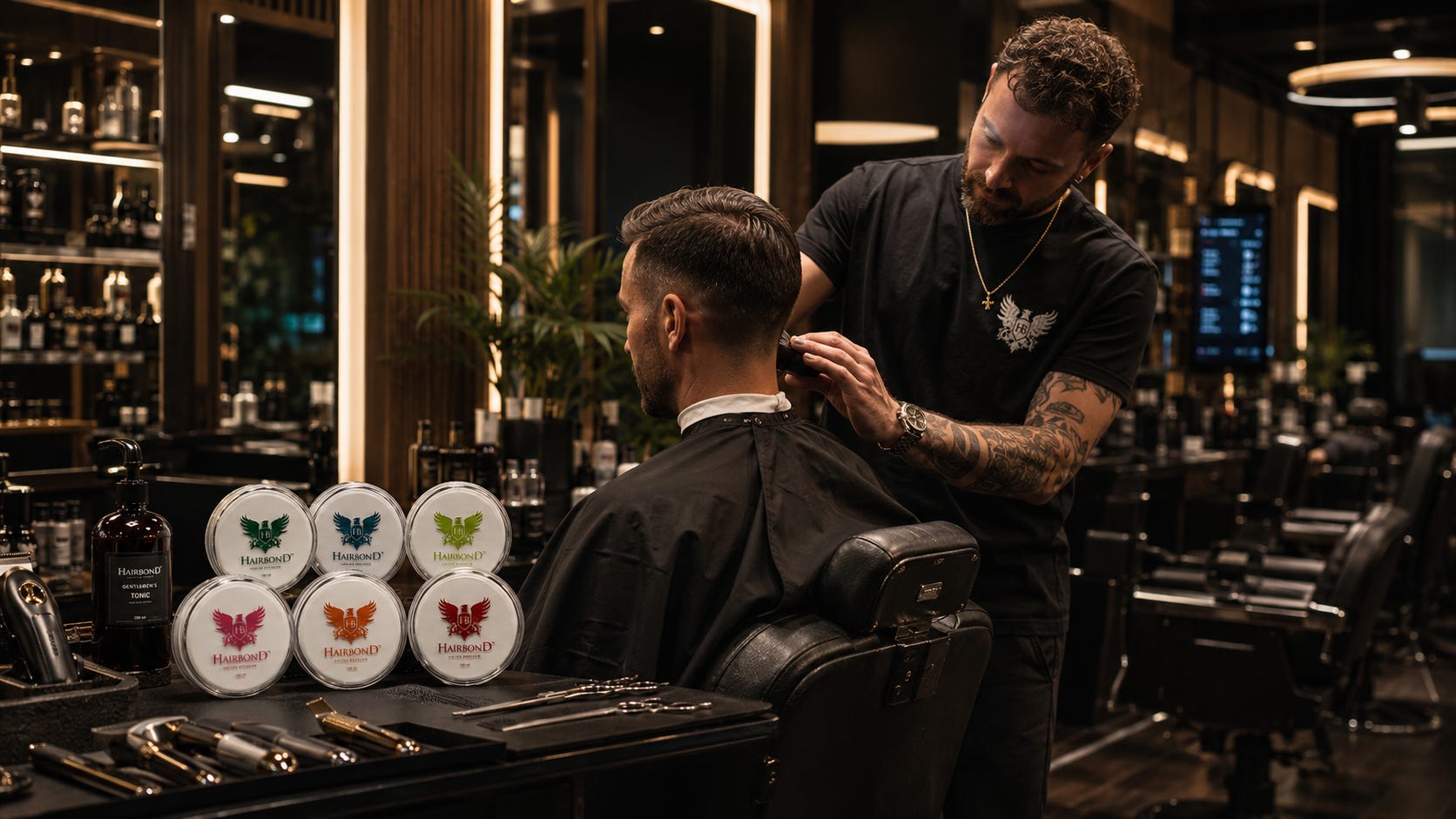
That is where Hairbond belongs.
Hairbond was built for the chair, not the boardroom.
We believe a product must earn its place through performance.
Not noise.
Not shelf space bought by a corporation.
Not an influencer holding a jar for eight seconds.
Performance.
The strongest professional brands of 2036 will win because hairdressers trust them.
The salon shelf may become smaller.
But it will become better.
Social media will lose its shine
Everybody will be able to create polished content.
That means polished content will become ordinary.
Perfect lighting will not prove skill.
An artificial caption will not build trust.
A million views from people who live nowhere near the salon will not fill Tuesday afternoon.
Real work will matter.
Real clients. Real reviews. Real transformations.
A hairdresser with a loyal local audience will often be worth more than an influencer with a huge but useless following.
Fame is not the same as a full column.
The future will reward relevance.
The experience will become more important
A haircut is never only a haircut.
It is the welcome.
The conversation.
The music.
The smell.
The coffee.
The silence when the customer wants silence.
The feeling that somebody has paid attention.
People crave human interaction.
That craving will grow.
By 2036, much of life may feel automated. Shopping, banking, work and customer service will happen through screens.
The salon and barbershop will remain physical.
That will be their strength.
For some customers, the person cutting their hair may be one of the few people they speak to properly that week.
That is not a small part of the service.
It is a big part of why they return.
People will pay more for places that make them feel known.
The best businesses will not rush customers through like units on a production line.
They will create an experience worth returning to.
The future belongs to proper professionals
Hairdressing will not disappear.
But the race to the bottom must.
Weak products will disappear.
Weak service will be exposed.
Tired shops will struggle to justify rising prices.
The winners will invest in skill, surroundings, customer experience and better products.
They will use technology without becoming robotic.
They will accept sensible regulation without allowing officials to regulate the soul out of the trade.
They will charge more because they have created something worth paying more for.
The scissors will remain.
The chair will remain.
The mirror will remain.
So will the need to sit down, speak to another human being and leave feeling better.
The next ten years will not belong to the cheapest salon.
They will belong to the best one.