


A man walks into a barbershop looking like he’s slept in a hedge.
Forty minutes later, he looks magnificent.
The barber has worked his magic. The sides are sharp. The weight is balanced. The fringe sits exactly where it should.
The customer admires himself in the mirror.
“Perfect, mate.”
He pays £40, walks out feeling like David Beckham and goes home.
The following morning, he washes his hair, rubs half a jar of styling product between his hands and attacks his head.
Five minutes later, he’s back to looking like the man who walked into the barbershop yesterday.
What happened?
The haircut didn’t disappear overnight.
The technique did.
I’ve been involved in hairdressing since I was a teenager. I founded Hairbond in 2008, and one thing has always bothered me about the men’s styling industry.
We spend a fortune cutting hair, then remarkably little time teaching people how to style it.
Men are sold jars promising maximum hold, incredible texture, extraordinary volume and enough control to survive a hurricane.
But nobody explains what happens before the jar comes out.
Or what might happen when two different products work together.
That’s where things get interesting.
The Great One-Jar Myth
For years, men have been encouraged to believe one styling product should do everything.
Volume. Texture. Shine. Hold. Movement. Definition.
All from one jar.
That’s like asking a goalkeeper to play centre-forward, take the corners and sell the pies at half-time.
He might have a go.
But you wouldn’t build a football team around it.
Professional hairdressing works differently.
A barber might use one product to prepare the hair, a hairdryer to establish the shape and another product to create the finish.
But there’s another possibility.
What happens when you combine two finishing products?
Could a little Shaper change the feel of Distorter?
Could Super give Shaper additional structure?
Could three established products create a finish that none delivers quite the same way individually?
That’s the idea behind The Hairbond Cocktail Bar.
Not a scheme to fill your bathroom with more jars.
An invitation to understand what is already inside them.
And, where it makes sense, experiment.
Behind the Bar: The Original Hairbond Trio
When Hairbond started in 2008, the ambition was simple.
Create professional styling products with distinct purposes.
Not three jars containing essentially the same thing with different labels.
Three different personalities.
Shaper Toffee: The Gentleman
Hairbond Shaper Toffee is about shape and pliable control.
It’s the product you reach for when you want the hair to look deliberate.
A classic quiff. A side part. A neat, controlled hairstyle that doesn’t need to look rigid.
Shaper brings discipline without demanding that every strand stands to attention.
Distorter Clay: The Rebel
Hairbond Distorter Clay has a different personality.
Matte texture. Separation. A more irregular finish.
It’s particularly useful for crops, messy fringes and hairstyles where the individual sections should remain visible.
Shaper likes order.
Distorter is quite happy causing a little trouble.
Super Fibre: The Enforcer
Hairbond Super Fibre is about structure and grip.
Quiffs that need height.
Short hairstyles requiring stronger control.
Shapes that need a more deliberate finish.
Super doesn’t necessarily want to look polished.
It wants to get the job done.
Three products.
Three distinct styling roles.
And four combinations worth exploring.
The Mixing Laboratory: Four Hairbond Cocktails
Before we start, an important distinction.
These are experimental starting ratios, not finished formulas that Hairbond has scientifically validated as blended products.
Combining styling products can change their texture, distribution, appearance and performance. Sometimes that works in your favour. Sometimes it doesn’t.
The sensible approach is to test tiny quantities in your hands, compare the result against each product used alone and never premix or store jars of homemade blends.
The best cocktail is the one that improves the hairstyle.
If the blend performs worse, don’t use it.
Cocktail 1: The Tailored Rebel
Shaper + Distorter
Starting experiment: 50% Shaper, 50% Distorter
Imagine a classic quiff that wants to look a little less formal.
Or a side part that needs some separation without becoming completely dishevelled.
That’s the idea behind The Tailored Rebel.
Shaper provides pliable control.
Distorter contributes matte texture.
The experiment is whether combining the two produces a finish that balances their different characteristics.
How to Try It
Start with completely dry hair.
Take a tiny amount of Shaper and an equal amount of Distorter. Keep the total mixture around a small pea for short hair.
Rub the products thoroughly between your palms.
Distribute through the hair, beginning away from the fringe.
Use your fingers to create the shape, then separate selected sections.
If the blend feels too stiff, drags through the hair or produces clumps, reduce the amount or try layering instead.
The barber’s test: Does it provide a more useful balance of shape and texture than Shaper or Distorter alone?
If not, there’s no reason to mix them.
Matchmaker’s verdict: A gentleman with just enough rebellion to make dinner interesting.
Cocktail 2: The Heavyweight Classic
Super + Shaper
Starting experiment: 60% Super, 40% Shaper
Some men want the structure associated with Super but prefer a little more pliability in the finished hairstyle.
That’s the thinking behind The Heavyweight Classic.
A structured quiff.
A swept-back short style.
Something with presence, but not necessarily the driest possible finish.
How to Try It
Blow-dry the hair into the intended shape first.
Take a tiny amount of Super and a slightly smaller amount of Shaper.
Warm the products thoroughly between your hands.
Work through the dry hair, starting at the back of the top section and finishing at the fringe.
Shape with your fingers or a comb.
Avoid adding more product simply because the hairstyle feels substantial.
The barber’s test: Does the blend retain Super’s structure while giving the hair a more workable finish?
Check whether the added product weight reduces volume.
If it does, Super alone may be better.
Matchmaker’s verdict: Strong enough to make a point. Civilised enough to know when to stop.
Cocktail 3: The Matte Architect
Distorter + Super
Starting experiment: 60% Distorter, 40% Super
This is perhaps the most intriguing combination of the three original products.
Distorter brings matte separation.
Super brings structure.
The idea is a hairstyle with visible texture that still has a deliberately constructed shape.
Think textured crops, short quiffs and thicker hair.
How to Try It
Begin with clean, dry hair that has already been directed into position.
Mix a very small amount of Distorter with a slightly smaller amount of Super in your palms.
Apply evenly through the top.
Use your fingertips to define individual sections.
Don’t force every strand into the same position.
The barber’s test: Does the combination improve separation and structure, or does it simply make the hair feel overloaded?
Pay attention to clumping, residue and how easily the product distributes.
Matchmaker’s verdict: Texture with a backbone.
Cocktail 4: The Triple Crown
Shaper + Distorter + Super
Starting experiment: 40% Shaper, 30% Distorter, 30% Super
Now we’re experimenting properly.
Three original Hairbond products.
Three different characteristics.
Pliability. Matte texture. Structure.
The question is whether combining all three can produce a balanced finish for a particular hairstyle.
Not whether using three products automatically makes a haircut better.
How to Try It
This is one for controlled experimentation, preferably with a barber.
Start with tiny amounts of each product, keeping the total quantity modest.
Blend them thoroughly between your hands.
Apply to dry hair that has already been blow-dried into shape.
Assess the distribution, texture, hold and appearance.
Compare the result against a simpler two-product combination.
The barber’s test: Is the third product actually improving anything?
If you can’t identify the benefit, leave it out.
Matchmaker’s verdict: Three personalities in one room. It might be brilliant. It might be an argument. That’s why we test it.
Mixing and Layering Are Not the Same Thing
This is where professional knowledge matters.
There are two ways to use multiple styling products.
Mixing means combining small quantities in your palms before applying them together.
Layering means applying one product, completing a styling stage and introducing another afterwards.
They can produce different results.
A mixture of Shaper and Distorter might behave differently from applying Shaper first and adding Distorter only to the sections requiring texture.
Likewise, applying a sea salt spray before blow-drying and finishing with Super is a layered routine, not a physical mixture.
Neither method is automatically better.
Layering is often easier to control because each product has a separate job.
Mixing can be interesting when you want to explore how two finishing products behave together.
But it requires experimentation.
And restraint.
If you’re new to professional styling, learn to use each product individually before combining them.
You wouldn’t start making cocktails before knowing what the bottles contained.
At least, not if you wanted to remember the evening.
Eight Signature Hairstyles From the Cocktail Bar
The original trio is only part of the Hairbond range.
As men’s hairstyles have evolved, so have the tools needed to create them.
Longer hair, natural curls and relaxed movement require a different approach from a heavily structured crop.
These eight signature styles show how preparation and finishing products can work together.
1. The Beckham
Texturiser + Super Fibre
Best for: Voluminous quiffs and textured height.
David Beckham has worn enough hairstyles to fill a barbering textbook.
Some were magnificent.
Others belong firmly in the early 2000s.
But the textured quiff remains one of his best.
The mistake men make is trying to create the entire hairstyle with a strong finishing product.
Volume starts before that.
Apply two or three light sprays of Hairbond Texturiser through towel-dried hair, adjusting for hair length and density.
Lift the fringe with a brush while blow-drying from the roots towards the ends.
Allow the shape to cool.
Then work approximately a pea-sized amount of Super through the dry hair, building only where needed.
Common mistake: Too much finishing product weighs down the very volume you’ve just created.
The verdict: Build the height with the dryer. Let Super maintain it.
2. The Shelby
Wonder Primer + Distorter Clay
Best for: Short disconnected crops and directional fringes.
Thomas Shelby didn’t look like a man who spent much time discussing leave-in conditioners.
Yet Cillian Murphy’s haircut in Peaky Blinders became a modern barbering classic.
Short sides. Longer top. A fringe with attitude.
Use Hairbond Wonder on damp hair when additional preparation is needed.
Blow-dry the top forwards, following the natural direction of the haircut.
Finish with a small amount of Distorter, using your fingertips to separate selected sections.
Common mistake: Too much clay turns a textured fringe into a solid lump.
If the hair already sits correctly, Distorter alone may be sufficient.
The verdict: The haircut creates the attitude. The clay adds the finishing character.
3. The Chalamet
Wonder Primer + Drifter Crème
Best for: Longer hair, loose layers and natural waves.
Timothée Chalamet represents a change in men’s hairstyles.
Less rigidity.
More movement.
Hair that looks like it belongs to the person wearing it.
Prepare damp hair with Wonder if it needs additional manageability.
Apply a modest amount of Hairbond Drifter Crème through the mid-lengths and ends.
Scrunch natural waves and allow the hair to dry gently.
For fine hair, start with a small-pea amount and increase only if needed.
Common mistake: Applying too much crème at the roots, flattening the hairstyle.
The verdict: Longer hair should move. Let it.
4. The Hardy
Texturiser + Forger Putty
Best for: Thick hair, rugged crops and stronger matte control.
Tom Hardy’s hairstyles often have a compact, slightly rugged appearance.
Nothing too precious.
Nothing overly polished.
For hair that needs additional grip, mist Texturiser lightly through damp hair.
Blow-dry with your fingers, creating a deliberate but slightly irregular shape.
Finish with a small amount of Hairbond Forger Putty.
Concentrate on areas requiring stronger control.
Common mistake: Using more putty to compensate for a haircut that carries too much bulk.
If the hair is already coarse or dry, skip the sea salt spray.
The verdict: Strong hair needs a plan. Not a wrestling match.
5. The Cavill
Shaper + Vector Gum
Best for: Classic side parts and neatly arranged medium-length hair.
A proper gentleman’s haircut has survived generations because it works.
Henry Cavill’s neatly arranged hairstyles demonstrate the appeal of traditional barbering.
Blow-dry the hair into a clean side part.
Apply a modest amount of Shaper to create the structure.
If selected sections need more definition or natural shine, introduce a tiny amount of Hairbond Vector Gum.
This is an optional finishing adjustment, not an invitation to coat the entire head twice.
Common mistake: Too much of both products makes the hair heavy.
The verdict: A gentleman’s haircut should look expensive. Not greasy.
6. The Bear
Wonder Primer + Drifter Crème
Best for: Naturally curly hair and soft definition.
Jeremy Allen White’s curls in The Bear are a reminder that men don’t need to flatten every strand into submission.
Sometimes the hair’s natural character is the best part.
Apply Wonder to damp hair if additional manageability is needed.
Gently detangle.
Work a small amount of Drifter through the lengths.
Scrunch upwards and allow the curls to dry naturally or with a diffuser on low airflow.
Once dry, leave them alone.
Common mistake: Repeated brushing or touching disrupts the curl pattern.
The verdict: Curls have their own personality. Stop trying to sack the manager.
7. The Heavyweight
Wonder Primer + Forger Putty
Best for: Dense hair, stubborn growth patterns and stronger control.
Some men have cooperative hair.
Others have hair that appears to have appointed its own legal representative.
A stubborn crown.
Dense growth.
A fringe determined to travel in the wrong direction.
Apply Wonder to damp hair where preparation is needed.
Use a brush and dryer to guide the hair into its intended position.
Allow the shape to cool.
Finish with Forger, concentrating on areas that need stronger control.
Common mistake: Using excessive putty to fight a growth pattern the haircut hasn’t accommodated.
The verdict: Strong hair requires a plan. Not endless negotiations.
8. The Boardroom
Wonder Primer + Shaper + Dimensions Hair Spray
Best for: Formal hairstyles and occasions requiring additional staying power.
Weddings.
Important meetings.
The sort of day when you don’t want to spend your afternoon checking your reflection in shop windows.
Prepare the hair with Wonder if needed.
Blow-dry into a neat side part or controlled sweep.
Use Shaper to create the finished hairstyle.
If additional staying power is required, apply a light finishing layer of Dimensions according to its directions.
Common mistake: Applying hairspray before the hairstyle is finished.
If Shaper already provides enough control, stop there.
The verdict: Look like you run the company. Not like you’ve borrowed the chairman’s wig.
The Most Important Styling Tool Isn’t in a Jar
If I could teach every man one thing about hair, it would be this.
Learn how to use a hairdryer properly.
When hair becomes wet, some of the temporary bonds involved in its shape are disrupted.
As the hair dries, those bonds can reform, helping it settle into a new temporary position.
That’s why a barber can create volume with a brush and dryer before applying any finishing product.
For a quiff, lift the roots.
For a side part, establish the direction.
For longer hair, work with the natural movement.
For curls, use gentle drying methods that preserve the pattern.
Allow the hair to cool in the intended shape.
Use appropriate heat rather than blasting it unnecessarily.
Then choose the finishing product.
You wouldn’t build a house without foundations.
Yet plenty of men try to construct a six-inch quiff with nothing but a handful of putty and optimism.
A Word to Barbers: Stop Asking the Wrong Question
There’s one question I’ve heard in barbershops for years.
“Do you want any product in that?”
I’ve never understood it.
The customer has paid for a professional haircut.
You’ve spent forty minutes creating shape, balance and texture.
You’ve checked the neckline. Perfected the fringe. Cleaned up the edges.
Then, at the very last moment, you ask whether he’d like you to finish the job.
Imagine a chef bringing a steak to the table and asking whether you’d like it cooked.
A better question is:
“What finish do you want?”
More volume?
A matte texture?
A classic side part?
Soft movement?
Natural curls?
Stronger control?
Now you’re having a professional conversation.
You’re explaining the haircut.
You’re teaching the customer how to maintain it.
And you’re demonstrating why you’ve selected a particular product.
Put the Product on the Customer, Not Just on the Shelf
I’ve never believed the best way to sell professional styling products is to leave them gathering dust on a retail display.
The best demonstration is the customer’s own head.
Use the product.
Let him see the difference.
Explain what you’re doing.
Show him how much to apply.
Teach him how to recreate the result at home.
And perhaps show him how two products can work together.
A little Shaper and Distorter for a different texture.
Texturiser followed by Super for a proper quiff.
Wonder followed by Drifter for softer movement.
But if he only needs one product, recommend one.
I’d rather a customer buy the right jar and come back than buy three he doesn’t understand and never return.
That’s not a lost sale.
That’s how you build trust.
Why Hairbond Has Evolved
When I founded Hairbond in 2008, shorter hairstyles dominated.
Quiffs.
Crops.
Strong, structured finishes.
Those styles haven’t disappeared.
But men’s hair has become more interesting.
Longer layers are returning.
Natural curls are being embraced.
Soft movement matters.
So does definition.
And some men still want a side part sharp enough to cut glass.
That’s why the Hairbond range has evolved.
Shaper, Distorter and Super remain central to our story.
Wonder and Texturiser help with preparation.
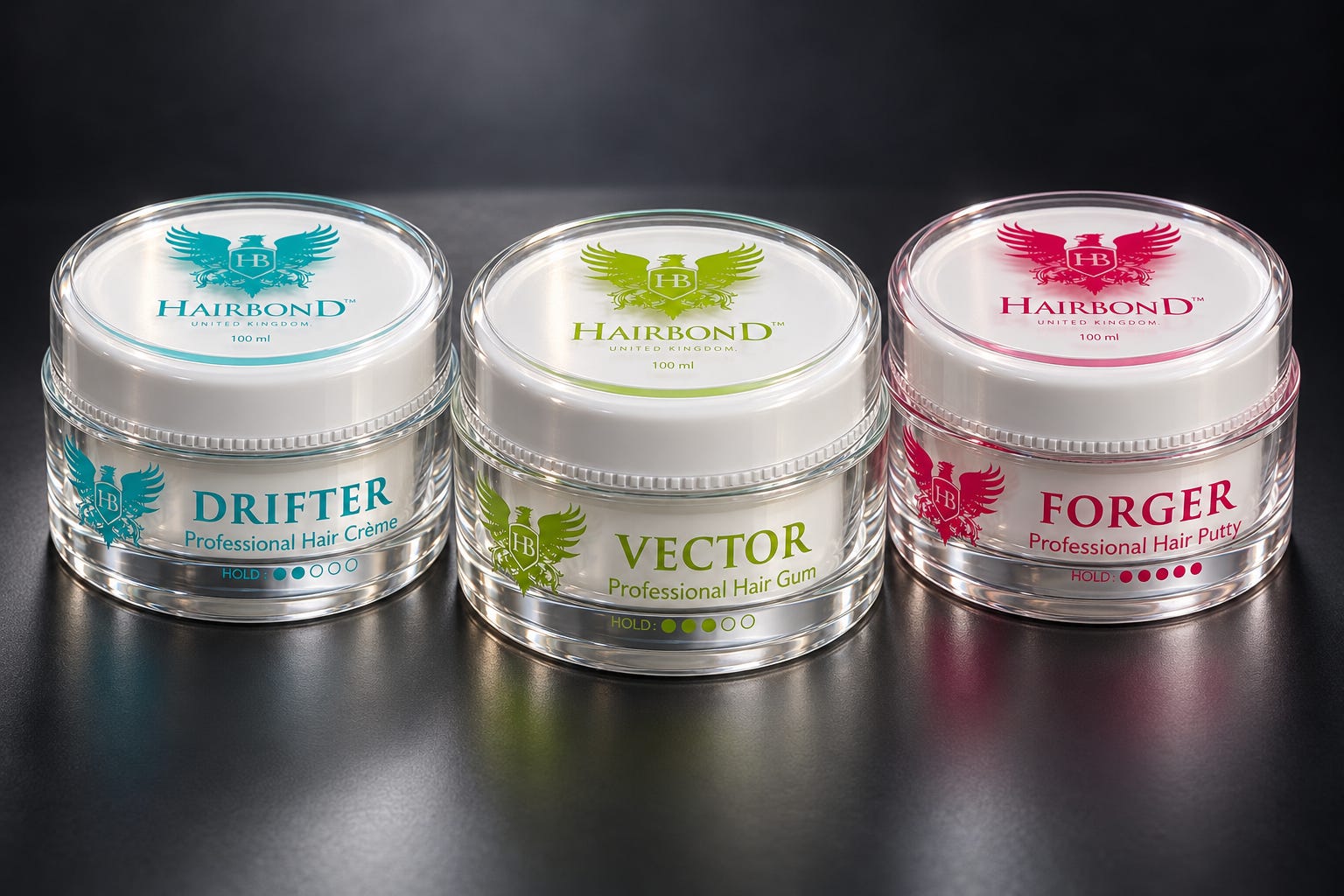
Drifter, Vector and Forger provide different options for modern styling demands.
But the original trio deserves another look.
Because before you decide you need another product, it might be worth understanding what you can achieve with the ones you already own.
That’s the spirit of the Cocktail Bar.
Not more products for the sake of it.
More knowledge.
More experimentation.
Better results.
Last Orders
A good haircut is like a good suit.
It should fit the person wearing it.
It should have character.
And it should never look as though somebody has tried too hard.
But even a good suit needs the right finishing touches.
Hair is no different.
The barber creates the foundation.
The technique establishes the shape.
The product provides the finish.
Sometimes that’s one jar.
Sometimes it’s two.
Occasionally, it’s a cocktail.
And sometimes the most interesting result comes from combining two products you thought you already understood.
That’s why I want people to experiment with Shaper, Distorter and Super.
Not blindly.
Not by emptying three jars into a bowl.
But thoughtfully, in small amounts, paying attention to what each product contributes.
If a blend works, you’ve discovered something useful.
If it doesn’t, you’ve learned something too.
Because the real purpose of the Hairbond Cocktail Bar isn’t to make men’s hair more complicated.
It’s to make professional styling easier to understand.
So the next time a man leaves the barbershop looking magnificent, he has a fighting chance of looking magnificent the following morning.
Without another appointment.
Without half a jar of product.
And preferably without looking as though he’s slept in a hedge.
The haircut deserves it.
Explore the full Hairbond Cocktail Bar guide with all 15 signature combinations.
Discover Shaper Toffee, Distorter Clay and Super Fibre at Hairbond.com.
Celebrity hairstyles and fictional characters are editorial references only. No endorsement, affiliation or personal use of Hairbond products is implied. Experimental mixing ratios are suggestions for small-scale styling trials, not validated product formulations.