


Another 4%.
That’s the latest surcharge we’ve been asked to pay to manufacture Hairbond because of rising fuel costs.
Not 4% more sales.
Not 4% more profit.
Another 4% on top of production costs that have already increased by more than 30% over the last six years.
Welcome to British manufacturing.
I’ve spent much of those six years trying to make our existing Hairbond stock last. Managing costs. Dealing with delays. Trying to keep a brand I started in 2008 moving forward when almost everything around it seemed to be getting more expensive.
COVID changed the world. Brexit brought its own complications. Global supply chains became unpredictable. Ingredients became harder to source.
And every time we thought production was moving forward, something else seemed to get in the way.
But finally, I have some good news.
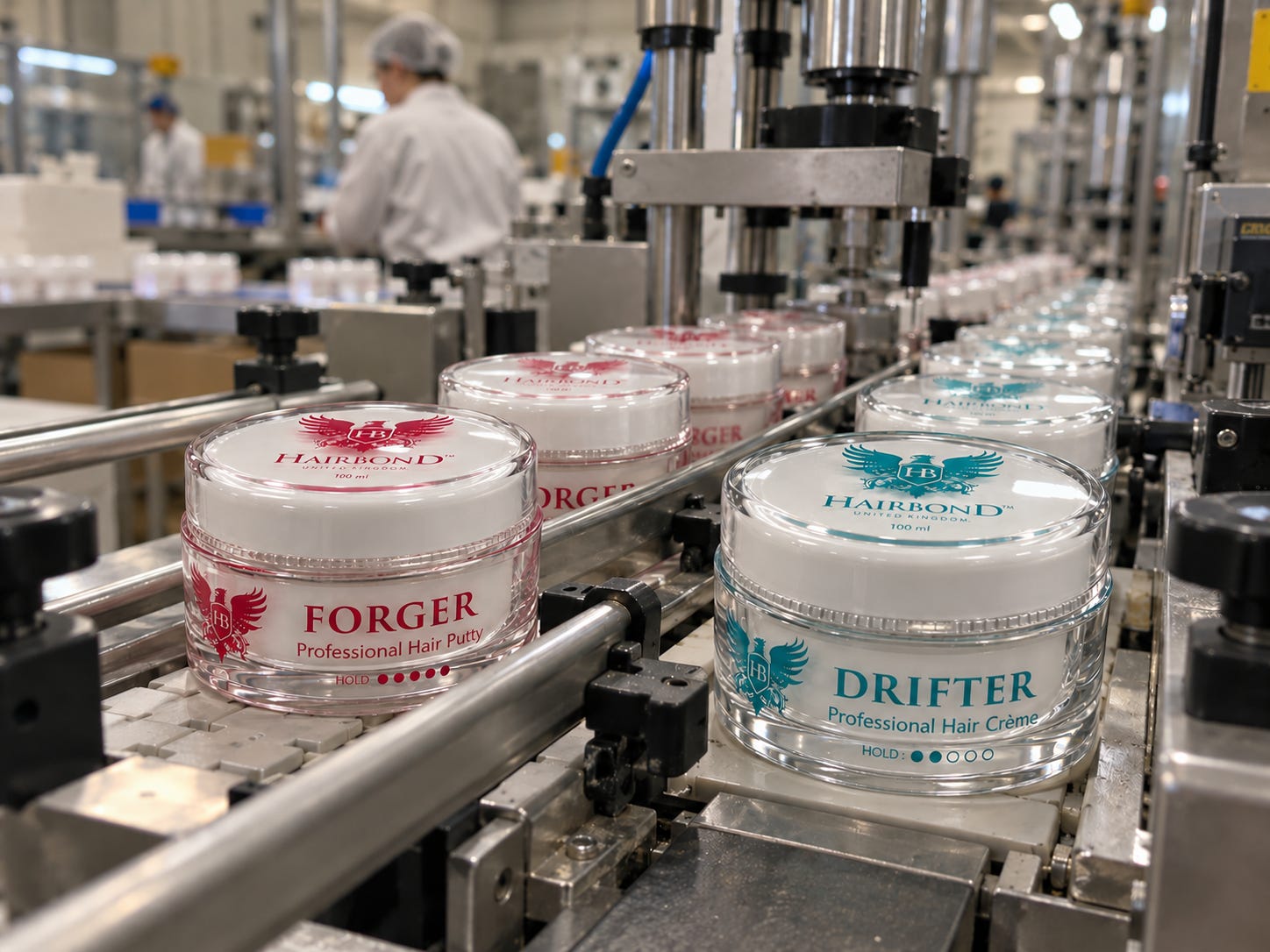
Hairbond’s new Drifter Crème and Vector Gum have arrived and are available to buy.
Forger Putty is following, with production still being completed.
It’s a moment I’ve waited a long time for.
And one that has made me think about something much bigger than Hairbond.
Do we really support independent British businesses? Or do we just like saying we do?
Six Years of Making Hairbond Last
When I started Hairbond in 2008, I wasn’t trying to build the world’s biggest professional hair care company.
I wanted to make products I believed in.
Products that performed. Products that looked good. Products that barbers, hairdressers and customers could genuinely enjoy using.
I wanted Hairbond to have its own identity.
Not another anonymous product fighting for space on a supermarket shelf.
Over the years, we built a brand with customers, professional relationships and a reputation that meant something to me.
But the last six years have tested that belief.
We’ve had to stretch stock far longer than I ever intended.
We’ve dealt with manufacturing difficulties, rising costs and the constant challenge of keeping products available.
There have been difficult decisions.
There have been mistakes.
Mine included.
And there have been moments when I’ve wondered whether all the effort was worth it.
Running a business can be a lonely experience.
People see the finished product. They don’t see the work behind it.
They don’t see the conversations with factories, the unexpected invoices or the time spent solving problems that shouldn’t exist in the first place.
And they don’t see how much energy survival can consume.
The trouble with spending six years keeping a business alive is that you can lose six years you should have spent growing it.
That’s what I want to change.
Hairbond has survived.
Now it needs to move forward.
More Than 30% Higher Production Costs. And Still Rising.
Let’s talk about the numbers.
Over the last six years, Hairbond’s production costs have increased by more than 30%.
Think about that.
If something previously cost £10 to manufacture, a 30% increase takes it to £13.
And that doesn’t automatically mean the customer is willing or able to pay 30% more.
Of course they aren’t.
Customers have their own bills.
Mortgages. Rent. Energy. Food. Transport.
Everybody is feeling the squeeze.
But so are the businesses making the things we buy.
COVID disrupted supply chains and manufacturing schedules.
Brexit introduced additional challenges for businesses trading and sourcing across borders.
And now global ingredient supply problems have delayed production at our UK factory.
Ingredients don’t always arrive when expected.
Manufacturing dates move.
Products that should be ready have to wait.
Meanwhile, we’ve been faced with another 4% fuel surcharge.
And that comes on top of everything else.
Packaging.
Warehousing.
Transport.
Distribution.
Insurance.
The costs involved in getting a finished jar into somebody’s hands.
None of it is getting easier.
And smaller businesses don’t have the same purchasing power as multinational corporations.
We can’t simply negotiate enormous global contracts or spread rising costs across hundreds of product lines.
We feel those increases directly.
The price of making something keeps rising. But the value of a customer’s money doesn’t rise with it.
That’s the problem.
And it isn’t unique to Hairbond.
Thousands of independent British manufacturers are dealing with their own versions of the same challenge.
Why Don’t We Just Make Hairbond Cheaper?
It’s a reasonable question.
If manufacturing costs are rising, why not find ways to make the products cheaper?
Use less expensive packaging.
Find cheaper ingredients.
Cut corners.
Reduce the quality.
There are certainly efficiencies we can make.
And we have to keep looking for them.
But there’s a difference between running a business efficiently and compromising the reason customers buy from you.
I’ve never wanted Hairbond to be the cheapest product available.
I wanted it to be one of the products people genuinely wanted to use.
A product that feels right in your hands.
A formula that performs.
Packaging that reflects the quality inside.
Something a barber or hairdresser can confidently recommend.
That has always mattered to me.
And I don’t want six years of difficult decisions to end with us stripping away everything that made Hairbond different.
We can change how we operate. We can improve how we sell. We can become more efficient.
But we cannot compromise the quality of the product.
Because if we do that, what exactly are we trying to save?
When Did Convenience Become More Important Than Quality?
Here’s something that has bothered me for years.
We live in a world where we can research almost anything.
We can read reviews.
Compare ingredients.
Find independent manufacturers.
Discover brands from every corner of the world.
Yet so much of what we buy comes from the same enormous companies.
Why?
Because they’re convenient.
They’re on the supermarket shelf.
They’re at the top of the search results.
They’re advertised everywhere.
They can be delivered tomorrow.
And we’ve become so accustomed to convenience that sometimes we forget to ask whether we’re actually buying the best product.
I’m not suggesting every large brand makes poor products.
That would be nonsense.
Some make excellent things.
And I’m not suggesting every independent brand deserves your money.
It doesn’t.
Being small doesn’t automatically make you good. Just as being big doesn’t automatically make you better.
But I wonder how many genuinely brilliant products never get discovered because their makers cannot afford to compete for attention.
Think about clothing.
Independent designers competing against enormous fashion companies.
Think about food.
Small producers competing against multinational brands for supermarket space.
Think about footwear, furniture, coffee, skincare and almost everything else we buy.
How many of us spend five minutes searching for something different?
And how many simply buy what we’ve always bought?
We’ve become very good at talking about supporting independent businesses.
I’m not sure we’ve become quite as good at actually doing it.
We Can’t Complain About Empty High Streets While Ignoring Independent Businesses
Every time another independent shop closes, people complain.
Another empty unit.
Another familiar name disappearing.
Another town centre beginning to look exactly like everywhere else.
We blame landlords.
We blame business rates.
We blame online shopping.
And sometimes we’re absolutely right.
But there’s another question worth asking.
When was the last time we deliberately chose an independent business over a major chain?
Not because it was cheaper.
Not because it was easier.
Because we believed the product or service was worth supporting.
A local business doesn’t disappear because somebody makes one purchase elsewhere.
It disappears when enough customers stop considering it.
And when it goes, the consequences extend beyond the owner.
Employees lose jobs.
Suppliers lose customers.
Communities lose something distinctive.
The money that once circulated through a network of local businesses goes somewhere else.
That’s not an argument against big business.
I’ve spent my life trying to build businesses. I’d be a hypocrite if I criticised somebody simply for becoming successful.
It’s an argument for choice.
For competition.
For giving independent businesses the opportunity to prove themselves.
We cannot demand interesting high streets while making every buying decision based entirely on convenience.
At some point, our spending habits have to reflect what we say we value.
The Barbering and Hairdressing Industry Is Fighting Its Own Battle
I’ve spent much of my working life around hairdressing.
I understand the trade.
And I think the public often underestimates what goes into it.
A good barber or hairdresser isn’t simply somebody who cuts hair.
They’re a skilled professional.
They understand shape, texture, movement and how different products behave.
They build relationships with customers.
They spend years developing their craft.
And they’re operating in an increasingly difficult environment.
Rents rise.
Energy costs rise.
Wages and staffing costs rise.
Training costs money.
Products become more expensive.
And customers understandably want value.
So where does the extra money come from?
It’s a question facing thousands of salons and barbershops.
And it’s why I believe professional hair care brands have to do more than simply sell products into the trade.
We need to help professionals demonstrate their skills.
We need to create products they genuinely want to use.
We need to give them something worth recommending.
I’ve never been particularly impressed by the idea of filling a barbershop with expensive retail displays and hoping somebody picks up a jar.
The best place to sell a hair product is in somebody’s hair. Not sitting untouched on a shelf.
Let the barber use it.
Let the hairdresser demonstrate it.
Let the customer see the result.
Then give them the opportunity to recreate that look at home.
That’s how trust is built.
And that’s the kind of relationship I want Hairbond to strengthen.
British Manufacturing Matters. But Quality Still Has to Win.
I believe Britain should be a country that makes things.
Not simply a country that imports them, puts a different label on them and spends millions advertising them.
We should be developing products.
Supporting skilled workers.
Encouraging manufacturing.
Giving entrepreneurs a reason to invest in ideas.
When somebody buys a product manufactured in Britain, the benefit can extend far beyond the brand itself.
There are factories.
Ingredient suppliers.
Packaging companies.
Printers.
Warehouses.
Transport businesses.
People whose work contributes to getting that product onto a shelf or into a customer’s hands.
Hairbond is part of that chain.
And I want it to remain part of it.
But I don’t believe customers should buy something simply because it says British on the packaging.
That isn’t enough.
British businesses have to earn their customers through quality, value and service.
We have to compete.
We have to innovate.
We have to make things people actually want.
And that’s exactly what we’re trying to do.
But if we want Britain to retain its independent manufacturers and specialist brands, customers need to be willing to discover them.
Otherwise, we risk becoming a country that talks about manufacturing while buying almost everything from somewhere else.
Hairbond Needs to Sell More. It’s That Simple.
Here’s the commercial reality.
I’m proud that Hairbond has survived six difficult years.
But survival isn’t enough anymore.
We need to become consistently profitable.
We need to improve our margins.
We need to get products into more people’s hands.
We need more barbers, hairdressers, retailers and distributors working with us.
And we need customers who discover Hairbond, enjoy the products and come back.
I could dress that up in corporate language.
Talk about strategic growth initiatives and market penetration.
But why bother?
We need to sell more Hairbond.
That’s the job.
We’re working around the clock to improve availability, develop relationships and find new opportunities.
And we have more products we want to bring to market.
But developing professional hair care products costs money.
Formulations have to be created.
Samples tested.
Ingredients sourced.
Packaging designed and purchased.
Manufacturing quantities committed to.
All before a customer buys anything.
Every jar sold helps cover those costs and creates the opportunity to invest in the next product.
That’s why these new launches matter.
Not simply because we’ve got something new to talk about.
Because they represent the next stage of Hairbond’s future.
Drifter and Vector Have Arrived. Forger Is Next.
After all the delays, it feels good to finally be talking about products again.
DRIFTER CRÈME
Our new professional styling crème is now in stock.
With a 2 out of 5 hold factor, Drifter is designed for natural movement, flexible styling and a relaxed finish.
For people who want their hair to look styled without feeling overly controlled.
VECTOR GUM
Our new styling gum has also arrived.
With a 3 out of 5 hold factor, Vector offers definition and control for versatile everyday styling.
FORGER PUTTY
Our new professional hair putty is the next product we’re waiting for.
With a 5 out of 5 hold factor, Forger is designed for stronger control and more structured styles.
Production has taken longer than planned, but we’re looking forward to making it available.
These products have been a long time coming.
Now we need to make sure people discover them.
You Can Help Hairbond Without Spending a Penny
I’m not asking anybody to buy Hairbond out of sympathy.
That’s not how I want to build a business.
If you buy our products, it should be because you like them.
Because they work.
Because you believe they’re worth the money.
But if you already use Hairbond, or believe independent brands deserve a fair opportunity, there are a few things that make an enormous difference.
Leave an honest review.
If you’ve bought Hairbond, tell people about your experience.
What did you like? How did you use it? What hairstyle did it help you achieve?
Genuine reviews help people make informed decisions.
And they help independent businesses get discovered.
Tell your mates.
If somebody asks what you’re using in your hair, tell them.
Word of mouth built brands long before social media existed.
It still works.
Tell your barber or hairdresser.
If you use Hairbond at home, ask whether they’ve tried it.
If you’re a professional using our products, show your customers what they can do.
Share this Journal.
You don’t have to buy anything.
If you enjoy reading about the realities of business, manufacturing and the hair industry, share our stories.
Send an article to somebody who runs a business.
Forward it to a barber or hairdresser.
Tell people what we’re trying to build.
Because I don’t want this Journal to become another collection of polished product advertisements.
I want it to tell the stories behind the business.
The challenges.
The mistakes.
The people.
The things that work and the things that don’t.
There are enough companies pretending everything is wonderful.
I’d rather tell you what’s actually happening.
A Thank You to Our Substack Readers. 20% Off This October.
If you’ve supported Hairbond over the years, thank you.
If you’ve bought our products, recommended us, left a review or simply read this Journal, I appreciate it.
So for the rest of October, we’re offering our Substack readers 20% off Hairbond.
Your October discount code: 20OFFHB
Shop at www.hairbond.com
Enter 20OFFHB at checkout to receive 20% off your order.
The offer remains live until 31 October 2026.
Drifter Crème and Vector Gum are available now, alongside our other products currently in stock.
If you’ve been waiting to try Hairbond, this is a good opportunity.
And if you enjoy what you buy, please leave us a review.
It really does help.
The Next Six Years Have to Be Different.
I’ve spent six years trying to make Hairbond last.
I don’t want to spend another six doing the same thing.
I want us to grow.
I want us to become profitable.
I want to develop new products, build stronger relationships with barbers and hairdressers, and work with independent retailers and distributors who believe in what we’re doing.
I want Hairbond to remain a British professional hair care brand with its own identity.
Not another anonymous product competing to be the cheapest.
And I want us to prove that an independent business can still succeed by making something people genuinely value.
There will be more challenges.
More unexpected bills.
More problems to solve.
That’s business.
But we cannot spend our lives complaining about the things we cannot control.
We have to concentrate on what we can.
Better products.
Better service.
Better relationships.
And earning every customer.
So next time you’re about to buy something, whether it’s a hair product, a pair of shoes, a coffee or almost anything else, perhaps spend five minutes looking beyond the obvious.
You might find something better.
You might discover an independent business doing something remarkable.
And you might help keep something worthwhile alive.
Because the future of independent British brands won’t be decided by how many people say they support them.
It will be decided by how many people actually do.
I’ve spent six years fighting to keep Hairbond alive.
Now it’s time to build its future.
And I’d love you to be part of it.
Scott Michaels
Founder, Hairbond
Established 2008
Shop Hairbond: www.hairbond.com
October discount: 20OFFHB
Read the Journal: journal.hairbond.com
Retail and distribution enquiries: business@hairbond.com