


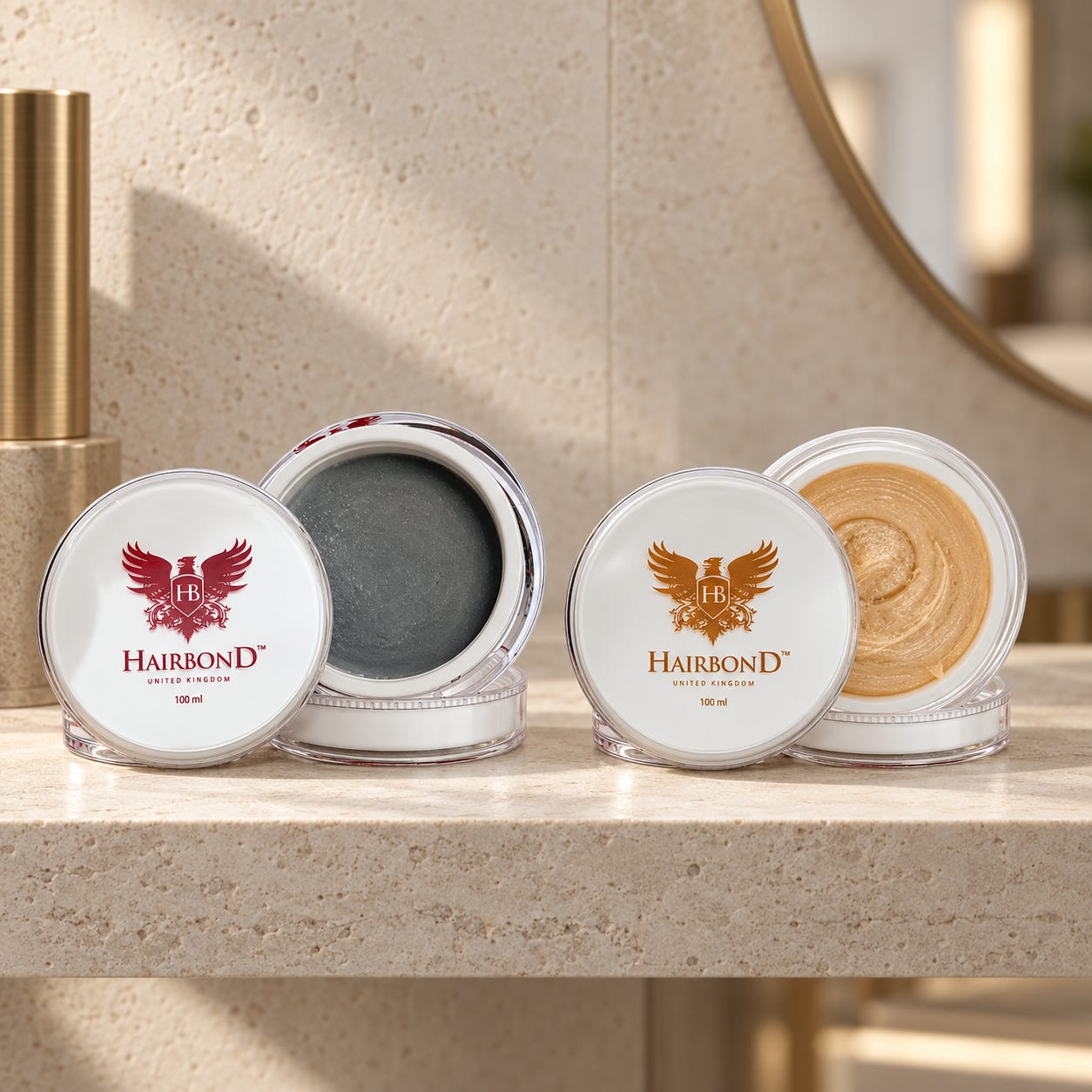
Most men blame the tub.
Half the time, the tub is innocent.
The product went onto the wrong hair, at the wrong stage, in the wrong amount.
I have seen products perform perfectly in a salon, only for someone to go home and decide they “do not work”. Same hair. Same product. Completely different result.
The missing detail is usually water.
Apply a product to damp hair and it generally spreads further, distributes more evenly and produces a softer result.
Apply it to dry hair and it usually gives more grip, stronger separation and a more visible finish.
Neither method is automatically better.
The correct question is not simply:
Should I put hair product on wet or dry hair?
It is:
What do I want my hair to do when I have finished?
The quick answer
If you only remember three things, remember these:
Soaking wet hair: rarely the right place for a Hairbond finishing product.
Towel-dried hair: best for preparation, even distribution and softer control.
Dry hair: best for grip, separation, texture and a more defined finish.
Preparation normally begins while the hair is damp.
Precision normally arrives when it is dry.
That is the principle. Now let us make it useful.
Wet hair and damp hair are not the same thing
Men often use the word “wet” to describe everything between stepping out of the shower and being completely dry.
That is not precise enough.
Wet hair is saturated. It may still be dripping, clinging together or holding visible water.
Damp hair has been towel-dried. It remains flexible and easy to shape, but it is no longer carrying excess water.
That difference matters.
If you apply a finishing product to soaking wet hair, the water changes the product before you have had a chance to control it. It may spread too thinly, lose grip and become difficult to place accurately.
The usual response is to add more.
By breakfast, half the tub is missing and the manufacturer is being blamed for a crime committed in the bathroom.
There are specialist curl products designed for application to very wet hair. This is not a rule for every formula ever created. It is a practical guide to getting better results from the Hairbond styling system.
For most Hairbond products, towel-dried or dry hair gives you far more control than dripping wet hair.
What damp hair does to a product
Damp hair allows a product to travel.
The moisture helps it move through the hair instead of catching immediately in one area. That makes damp application useful when you want:
More even distribution
A softer finish
Less aggressive separation
Movement rather than rigid definition
A foundation that can be shaped as the hair dries
This is where preparation products earn their place.
A product applied at this stage becomes part of the styling process. It is helping you create the finished shape rather than being asked to rescue it afterwards.
Damp application can also make creams, gums and flexible stylers feel lighter. The trade-off is that the final hold and texture may be softer than when the same product is applied to dry hair.
That is not product failure.
That is a different result.
What dry hair does to a product
Dry hair gives you greater precision.
You can see the finished shape, identify where control is required and place the product exactly where it needs to go.
Because there is no excess moisture helping it spread, the product tends to remain more concentrated. That usually means:
More grip
Stronger definition
Clearer separation
A drier or more matte appearance
Greater control over individual sections
This is why clays, fibres and putties are commonly used on dry hair.
The advantage is performance.
The risk is over-application.
A large amount of product placed straight onto dry hair can catch in one area, overload finer hair or create a finish that looks coated rather than styled.
Dry hair gives you more control, but it also exposes poor technique. The product cannot hide the evidence.
The Hairbond application guide
Here is the sensible starting point for the Hairbond range.
Hair length, density and condition will still affect the result, so treat this as a professional starting position rather than a law carved into a salon mirror.
Hairbond Wonder: start with damp hair
Hairbond Wonder belongs near the beginning of the routine.
Apply it through clean, towel-dried hair before styling. Its role is to prepare the hair, improve manageability and create a better foundation for whatever comes next.
Wonder is not there to produce a heavy finished hold.
Think of it as preparation, not decoration.
Hairbond Texturiser: apply while the hair is damp
Hairbond Texturiser Sea Salt Spray is designed to help build grip, movement and texture.
Apply it evenly through damp hair before creating the shape. As the hair dries, the Texturiser helps provide the foundation for a looser, more natural finish or for a stronger finishing product.
It can be used sparingly on dry hair for a refresh, but spraying until the hair is wet again rather defeats the exercise.
Hairbond Drifter: towel-dried for softness, dry for separation
Hairbond Drifter Professional Hair Crème is made for movement, touchability and natural control.
Apply it to towel-dried hair when you want an even, relaxed finish that moves naturally.
Use it on dry hair when you want more visible separation, slightly greater definition and easier restyling with the fingers.
Drifter is not intended to freeze the hair into position. If you want the hairstyle to survive like a concrete monument, you have chosen the wrong job for the product.
Hairbond Vector: damp for polish, dry for definition
Hairbond Vector Professional Hair Gum provides definition, structure and reworkable control.
On towel-dried hair, expect a smoother and more evenly distributed result with natural-looking polish.
On dry hair, Vector should give clearer separation and more deliberate structure.
Use the damp method when the whole style needs control. Use the dry method when particular sections need definition.
Hairbond Shaper: slightly damp or completely dry
Hairbond Shaper Toffee sits in the useful middle ground between movement and control.
Applying a small amount to slightly damp hair can create a smoother, more polished shape.
Applying it to dry hair gives more noticeable texture, separation and flexible control.
Shaper has always been versatile. The mistake is assuming versatility means using the same amount in the same way for every hairstyle.
It does not.
Hairbond Distorter: use on dry hair for the proper matte result
Hairbond Distorter Clay is at its best when warmed thoroughly between the hands and applied sparingly to dry hair.
This allows the clay to create matte texture, separation and controlled shape.
Applying Distorter to wet hair spreads it more thinly and can weaken the dry, textured finish people usually choose a clay to achieve.
If matte texture is the destination, dry hair is the cleaner route.
Hairbond Super: dry hair for structure and stronger control
Hairbond Super Fibre is for stronger hold, lift, definition and fuller-looking texture.
Apply a small amount to dry hair and work it through gradually.
The fibre needs somewhere to grip. Dry hair gives it that opportunity.
Pay particular attention to quantity on finer hair. The objective is to create structure, not announce the presence of styling product from across the room.
Hairbond Forger: dry hair for deliberate texture
Hairbond Forger Professional Hair Putty is built for texture, shape and strong, adaptable styling.
Start on dry hair after the basic shape has been created.
Warm a small amount completely, apply it through the hair and then add more only where additional control is genuinely needed.
Forger should make the style look intentional.
It should not make the hair look as though it lost an argument with a candle.
How much hair product should you use?
There is no universal “pea-sized amount” because peas do not all have the same hair.
Length, thickness, density and the strength of the product all matter.
A useful starting point is:
Very short or fine hair: approximately half a pea-sized amount
Short-to-medium hair: approximately one pea-sized amount
Longer, thicker or denser hair: one small amount followed by a second application only if required
The important part is not the exact measurement.
It is the sequence.
Start small. Distribute it properly. Look at the result. Then decide whether more is needed.
It is easy to add product.
Removing it usually involves a sink, a towel and some language unsuitable for the product page.
Where should you apply hair product first?
Not the fringe.
Starting at the front concentrates the greatest amount of product in the most visible part of the hairstyle. That can make the fringe look heavy while leaving the back and sides untouched.
Instead:
Warm the product fully between your palms and fingers.
Enter the hair from the back or underneath.
Distribute through the lengths.
Work towards the sides and crown.
Finish with the front using whatever remains on your hands.
For lift and structure, work closer to the roots without rubbing product directly into the scalp.
For separation and surface texture, concentrate more on the mid-lengths and ends.
For longer, looser hair, avoid loading the roots with heavy finishing product. Too much weight in the wrong place can remove the movement you were trying to create.
Five mistakes that make a good product look bad
1. Applying finishing product to dripping hair
The product becomes diluted before you can control its placement.
Towel-dry first unless the formula specifically tells you otherwise.
2. Using the full amount in one go
One large application creates one large opportunity to get it wrong.
Two small applications provide far more control.
3. Failing to warm the product
Clay, fibre, gum and putty should not enter the hair as a cold lump.
Work the product until it is evenly spread and nearly invisible across the hands.
4. Applying product before deciding on the shape
A finishing product should strengthen a direction that already exists.
It should not be expected to invent the entire hairstyle after the drying and shaping have been abandoned.
5. Layering products without giving each one a job
More products do not automatically produce a better result.
Preparation, building and finishing are separate jobs. If two products are trying to do the same thing, one may simply be adding weight.
Every product in the routine should be able to explain why it is there.
Run your own two-day test
If you are unsure whether your chosen product works better on damp or dry hair, stop guessing.
Test it.
On the first day, apply a measured amount to towel-dried hair. Style it normally and take a photograph once completely dry.
On the second day, use the same amount, but apply it after the hair is fully dry.
Compare:
Hold
Shine
Texture
Movement
Separation
How the hair feels several hours later
You will learn more from that controlled comparison than from adding three times as much product and hoping for a personality change.
The final rule
Hair product is not simply something you put on.
It is something you use at a particular moment to create a particular result.
Use damp hair for preparation, distribution and softer control.
Use dry hair for grip, texture and precision.
Use less than you think, warm it properly and give every product one clear job.
The difference between a tub that disappoints and a product you reorder may be nothing more than ten minutes of drying and thirty seconds of better technique.
The tub might have been innocent after all.