

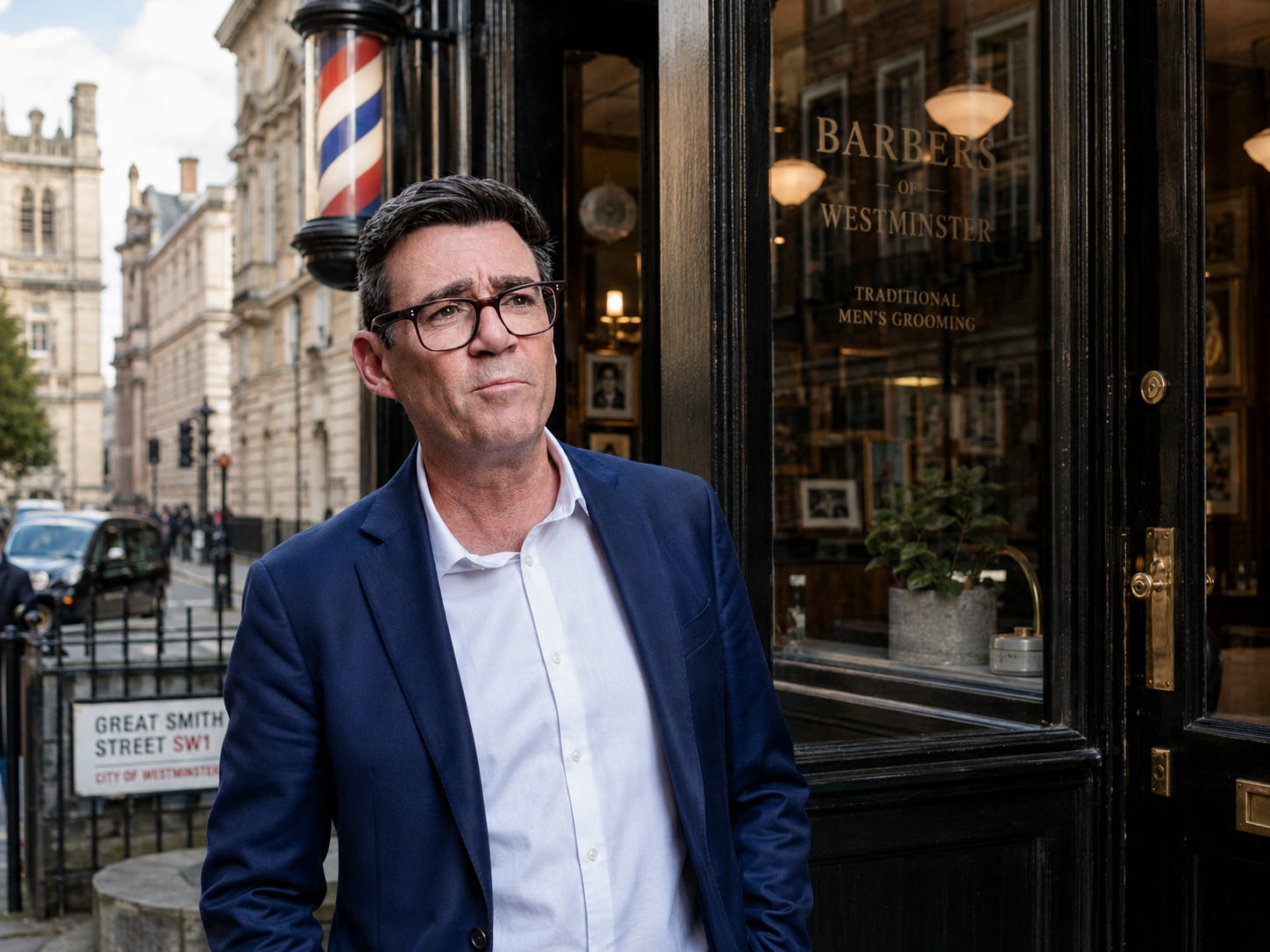
Andy Burnham became Prime Minister on 20 July 2026.
Three days later, his Government announced a further 20% cut in business-rates bills for pubs, social clubs and qualifying live music venues across England from April 2027.
Nearly 32,000 venues are expected to benefit. The typical pub is estimated to save £1,100 next year.
Good.
Pubs matter.
They create jobs.
They bring people together.
They give communities somewhere to meet, laugh and explain why England would win the World Cup if the manager simply listened to Dave near the fruit machine.
They deserve support.
But, Prime Minister, the high street does not end at the pub door.
It includes the barbershop next door.
The salon across the road.
The apprentice sweeping the floor.
The owner working six days a week.
And the British businesses making the products sitting on their shelves.
Back the pub.
But do not save one high-street door while taxing the next one shut.
The businesses that keep people coming back
Barbershops and hair salons create something every high street needs.
Repeat visits.
Customers return every few weeks.
They park nearby.
Buy coffee.
Visit shops.
Meet friends.
Sometimes they go to the pub afterwards looking suspiciously younger.
These businesses cannot move online.
They cannot send the work abroad.
They cannot replace skilled people with a chatbot and call it innovation.
A haircut requires a person, a chair and trust.
A good barber also provides somewhere men talk.
Sometimes it is the only place they talk.
Work.
Money.
Relationships.
Health.
Usually while claiming they only came in for a quick tidy-up.
Hairdressers play the same role.
People visit before weddings, interviews, funerals, holidays, first dates and fresh starts.
They often walk out standing slightly taller.
That is not vanity.
That is confidence.
Hairbond understands this because confidence has always been the real product.
The jar matters.
The formula matters.
But how somebody feels when they leave the chair matters more.
You cannot reclaim VAT on somebody’s hands
The VAT registration threshold is currently £90,000 in taxable turnover.
That may sound like a successful business.
Turnover is not profit.
A salon must pay rent.
Wages.
Employer National Insurance.
Energy.
Water.
Insurance.
Laundry.
Training.
Stock.
Card fees.
Repairs.
And one hairdryer that appears to require replacing every fortnight.
Hairdressing and barbering are labour-intensive industries.
That should be considered a strength.
They employ people.
They train people.
They create skilled careers that cannot be outsourced.
But labour does not carry input VAT.
You can reclaim VAT on qualifying products and equipment.
You cannot reclaim VAT on somebody’s hands.
That is the problem.
A salon grows.
It employs staff.
It builds a strong clientele.
It approaches the threshold.
Then the tax system presents the owner with several exciting options.
Increase prices.
Accept less profit.
Reduce employment.
Stop growing.
Or restructure the business so fewer people are directly employed.
Then Westminster holds another meeting about the decline of apprenticeships.
It is not a mystery.
It is arithmetic wearing a suit.
Cut VAT on professional hair services
The Prime Minister should reduce VAT on professional hairdressing and barbering services to 10%.
Clear.
Permanent.
No complicated application process designed by somebody who has never run a small business.
Leave more money inside the businesses doing the work.
That money will pay wages.
Fund training.
Support apprentices.
Improve premises.
Buy equipment.
Purchase stock.
And perhaps even provide a modest profit for the person who signed the lease, guaranteed the bills and lies awake wondering whether Tuesday will be busy.
The National Hair and Beauty Federation’s 2026 industry research found businesses operating with limited financial resilience, with VAT reform among the sector’s leading demands.
A reduced rate would not be a handout.
It would stop punishing a people-based industry for employing people.
Extend business-rates support beyond pubs
The Government says pubs, clubs and music venues help communities and keep high streets busy.
Correct.
So do barbershops.
So do salons.
They occupy physical premises.
They employ locally.
They create regular footfall.
They provide services people cannot buy from an overseas marketplace that may or may not have discovered British tax law.
These businesses deserve meaningful business-rates relief too.
Not another consultation.
Not a ministerial roundtable followed by a photograph of everyone looking deeply concerned.
Relief.
If the Government believes some businesses make a positive contribution to their communities, it should recognise the people who open their doors every morning and serve those communities face to face.
The barber matters before the pint as well as after it.
Keep the margin in Britain
Support must not stop at the salon chair.
It must reach the British companies supplying the industry.
Hairbond works with British suppliers to develop and produce professional hair products.
That supports British formulation.
British manufacturing.
British filling.
British packaging.
British employment.
British tax revenue.
It also costs more than importing the cheapest available product, putting a dramatic animal on the label and announcing that masculinity has been reinvented.
Apparently, it happens twice a week.
British manufacturers absorb rising costs throughout the supply chain.
Ingredients.
Packaging.
Testing.
Compliance.
Energy.
Wages.
Warehousing.
Transport.
Retail margin.
The Government takes its share early.
It rarely helps unload the van.
The Prime Minister should create stronger tax incentives for independently owned companies that genuinely develop, manufacture, fill or pack products in Britain.
Not products that arrive from overseas and receive a Union Jack sticker near the warehouse door.
Real British production.
Make products here.
Employ people here.
Pay tax here.
Get rewarded here.
That is industrial policy without the conference lanyard.
Margin is not greed
Politicians sometimes talk about business margin as though it is money found behind the sofa.
It is not.
Margin funds the next employee.
The next apprentice.
The next formula.
The next production run.
The next piece of machinery.
The next export order.
The next risk.
Take every spare pound from a business and it does not become stronger.
It becomes cautious.
Then tired.
Then smaller.
Then closed.
The Treasury collects very little from a boarded-up shop.
Let more of the margin remain with British businesses.
They will invest it.
Employ with it.
Build with it.
That is growth.
Not the word “growth” printed behind a minister while another independent business quietly disappears.
Three decisions
The Prime Minister should make three decisions.
Reduce VAT on professional hairdressing and barbering services to 10%.
Extend meaningful business-rates relief to barbershops and salons.
Reward genuine British manufacturing and allow more of the margin to remain with the businesses creating British products and jobs.
Simple enough to explain.
Serious enough to matter.
Back the whole high street
Andy Burnham has built his political identity around understanding towns, communities and working people.
Now he has the chance to prove it.
Back the pub.
Back the barber.
Back the hairdresser.
Back the British manufacturer supplying them.
The high street is an ecosystem.
The pub pours the pint.
The barber cuts the hair.
The salon builds confidence.
The British supplier keeps products on the shelf.
They support one another.
Government policy should do the same.
Prime Minister, do not stop at the pub door.
Reduce the tax.
Protect the margin.
Back the people already doing the work.
Britain does not need another government that talks about growth.
It needs one that stops taxing growth out of the people creating it.