


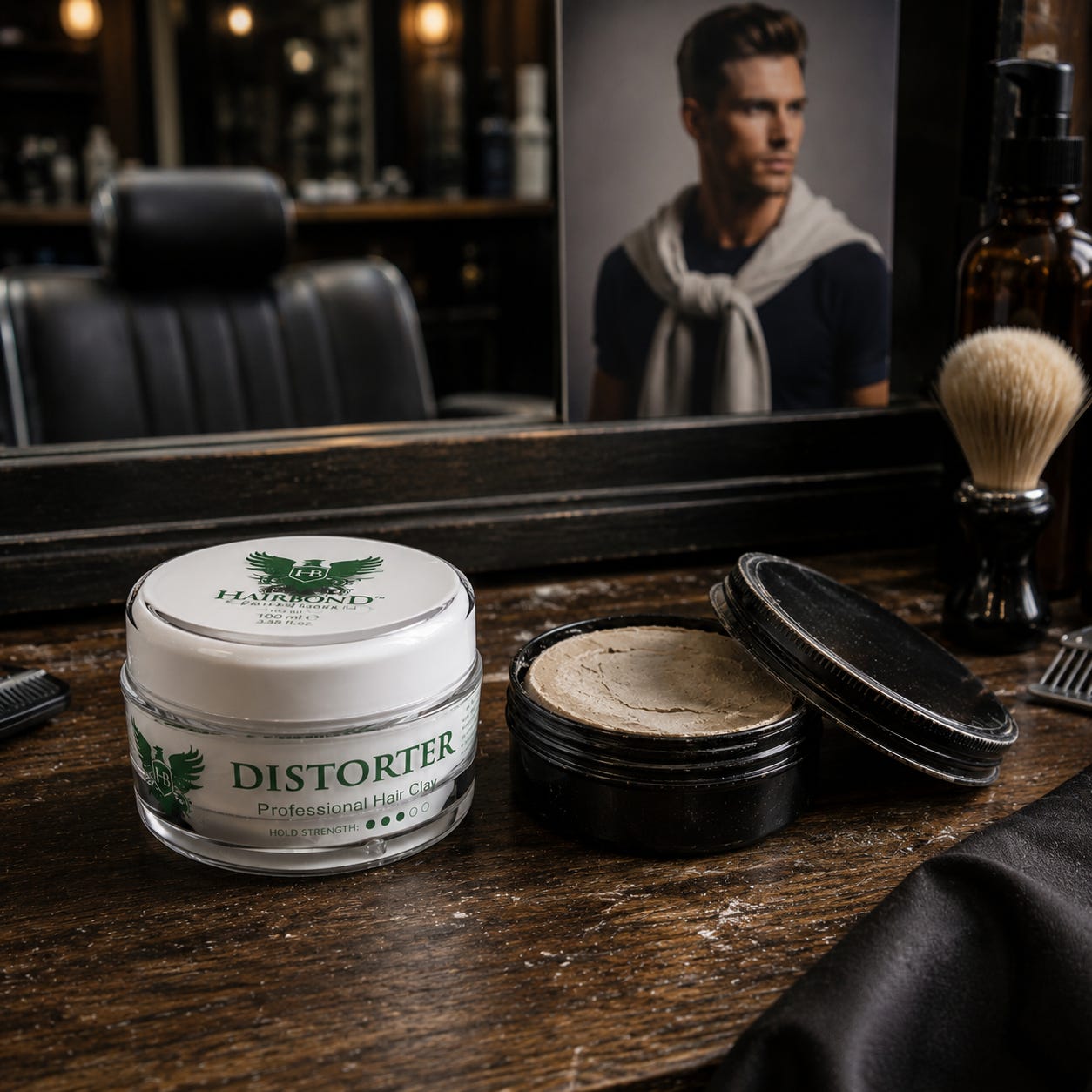
I sold American Crew in 1998. Nearly thirty years behind the chair taught me that shelf space is not proof, packaging can lie and familiar does not always mean best.
There are more premium men’s hair brands than ever.
At least, that is what it says on the tin.
Black packaging.
Gold lettering.
Moody photography.
A serious-looking bloke staring into the distance as though his hair clay has just delivered some difficult news.
It looks expensive.
Then you open it.
That is where the truth begins.
Some so-called premium products look like shoe polish.
Others feel like petroleum jelly in a designer jar.
Add fragrance.
Print the label in gold.
Find a model with folded arms.
Charge £25.
Premium has arrived.
Apparently.
Hairbond was built differently.
I started working in a barbershop in 1998.
I later owned a salon for ten years. I cut thousands of heads. I used products all day, not once for a photograph.
A barber finds out quickly whether a product is any good.
It spreads or it drags.
It holds or it gives up.
It creates texture or leaves the hair feeling like plaster.
There is nowhere to hide.
A clever label cannot rescue a weak clay once the customer looks in the mirror.
I Sold American Crew in 1998
We sold American Crew in the first barbershop I worked in.
I handled the tubs.
I used the products.
I recommended them to customers.
This is not an opinion formed after seeing an advert last Tuesday.
American Crew deserves credit.
It helped bring professional men’s hair products into salons and barbershops when the category was still young.
But I found the brand boring then.
I find it even more boring now.
The polished American man.
The safe haircut.
The jumper tied around his shoulders.
The faint suspicion that he owns a yacht and calls everybody “buddy.”
How many British lads wanted to look like that?
I never met many in Lancaster.
Perhaps they were all sailing.
The products and campaigns may have changed over the years.
The feeling never changed much for me.
Safe.
Polished.
Corporate.
A snorefest with excellent distribution.
That distribution mattered.
The brand already had the wholesalers.
The sales teams.
The buyer relationships.
The scale that makes a familiar decision feel like a safe one.
New brands had to knock.
Familiar Does Not Mean Best
When a product appears everywhere, people assume it must be the best.
Sometimes it is.
Sometimes it is simply the easiest brand for a buyer to choose.
It arrives on time.
It offers a workable margin.
It funds promotions.
Its representative already knows the buyer.
Those things matter in business.
They do not make a wax spread better.
They do not stop a clay dragging through the hair.
They do not prevent a putty waving a white flag before lunch.
I watched buyers become sellers.
Then sellers became buyers.
The same people moved around the same businesses.
The names on the doors changed.
The relationships remained.
Nobody gets blamed for choosing the brand everybody already stocks.
Trying something new requires judgment.
Ordering the familiar tub requires a purchase order.
That is how an industry becomes stale.
Not through one grand conspiracy.
Through thousands of comfortable decisions.
The buyer wants reliable supply.
The distributor wants margin.
The sales representative wants the easiest sale.
The corporate brand wants another shelf.
The barber is told this is what customers want.
The customer is rarely asked.
Small brands are told to prove demand before receiving distribution.
Without distribution, building that demand becomes harder.
A charming little circle.
Very efficient.
Unless you are standing outside it.
Premium Is Not a Black Tin
The word premium has been stretched so far it now means almost nothing.
A black tin is not premium.
Gold lettering is not premium.
A high price is not premium.
Sometimes it is simply expensive.
Some tins look impressive when first opened.
Then a poor seal lets air reach the formula.
The product begins to dry.
Six weeks later, the contents resemble a scented hockey puck.
Or a bar of soap abandoned in a Travelodge.
Still premium, according to the label.
Packaging has a job.
It must protect the formula.
It must survive being opened every day.
It must keep the product usable.
Looking handsome in a photograph is not enough.
A beautiful container may win the first sale.
Only a good product earns the second.
We Tried Powder
Hairbond made a styling powder early.
It was a good product.
The packaging was not good enough.
But I also became uncomfortable with the category.
Fine powder is applied close to the face.
It can drift through the air and end up around the nose or mouth.
That concerned me.
I am not making sweeping medical claims.
I am not wearing a white coat.
I am a hairdresser deciding what I feel comfortable selling.
Some lads leave barbershops with so much white powder across their shoulders they look as though they have wandered off the set of Scarface.
It may look dramatic on TikTok.
It did not look like the future of Hairbond to me.
So we moved on.
No powder empire.
No hype train.
No pretending gravity had finally been defeated.
Hairbond had already found its ground.
Waxes.
Clays.
Putties.
Products with substance.
Products you can control.
Products that stay where you put them.
Proper Styling Products
A proper wax should work through the hair without turning greasy.
A clay should create texture without making the hair feel like a garden wall.
A putty should provide control, movement and hold.
It should still be there after lunch.
These products are harder to make well than people realise.
The spread matters.
The hold matters.
The finish matters.
The fragrance matters.
The washout matters.
A formula can look perfect in the jar and fail the moment it touches hair.
It can feel strong for five minutes and disappear two hours later.
It can promise a matte finish and leave the customer shining like a polished bonnet.
That is not premium.
That is a refund waiting to happen.
Barbers notice.
They use products repeatedly.
They see what happens after the photograph.
They know when a wax is greasy.
They know when a clay drags.
They know when a putty lacks control.
They also know when a brand has spent more on models than materials.
Shelf Space Is Not Proof
A product being everywhere does not prove it is exceptional.
It proves the company knows how to get it everywhere.
That is a skill.
It is not the same skill as making the best product.
The professional hair trade has rewarded availability before excellence for years.
Relationships before innovation.
Scale before imagination.
Comfort before courage.
Then everyone wonders why the shelves look the same.
Corporate brands are not unbeatable.
They are familiar.
That is different.
Hairbond had none of those advantages when it started.
We had a salon in Lancaster.
We had customers.
We had barbers who would tell us immediately when something was wrong.
That was our advantage.
A corporate board can approve a product.
A barber has to use it.
The board studies margins.
The barber studies the mirror.
Hairbond Had to Earn It
Hairbond had no automatic listings.
No multinational owner.
No inherited sales force.
No buyer carrying us into their next job inside a briefcase.
We had to win one barber at a time.
The product had to perform.
The jar had to stand out.
The barber had to trust it enough to recommend it.
The customer had to buy it again.
That is a harder route.
It is also a better test.
Hairbond was built behind the chair.
Not inside a boardroom.
Not from a trend report.
Not because a buyer needed another black tin to complete the shelf.
It came from the work.
The haircuts.
The customers.
The mistakes.
The repeat sales.
The products that earned loyalty.
That cannot be faked with gold lettering.
Branding Must Be Earned
Hairbond believes in branding.
Of course it does.
We would not have survived eighteen years without it.
The jar matters.
The colour matters.
The name matters.
The fragrance matters.
How the product feels in the hand matters.
But the packaging must represent the formula.
It must never distract from it.
Some so-called premium products are cheap formulas wearing a dinner jacket.
They look confident.
They say the right things.
Then the music starts and they cannot dance.
Hairbond is not interested in that game.
We do not sell customers an image and hope they forgive the product.
Every jar has to justify the name on the front.
Let Them Keep the Hype
Hairbond is not interested in chasing every trend.
We do not need to launch whatever is moving fastest on TikTok.
We do not need to pretend every new texture is a revolution.
Most revolutions now arrive in plastic packaging and are forgotten by Thursday.
Hairbond knows what it is.
Professional waxes.
Professional clays.
Professional putties.
Built from experience behind the chair.
Made for barbers who care about the finished result.
Made for customers who expect their hair to stay styled after leaving the bathroom.
The corporate brands can keep their comfortable shelf space.
The powder brands can keep shaking bottles for the camera.
Hairbond will keep making products that work when nobody is filming.
Being familiar is useful.
Being fashionable is useful.
Being good is better
.