


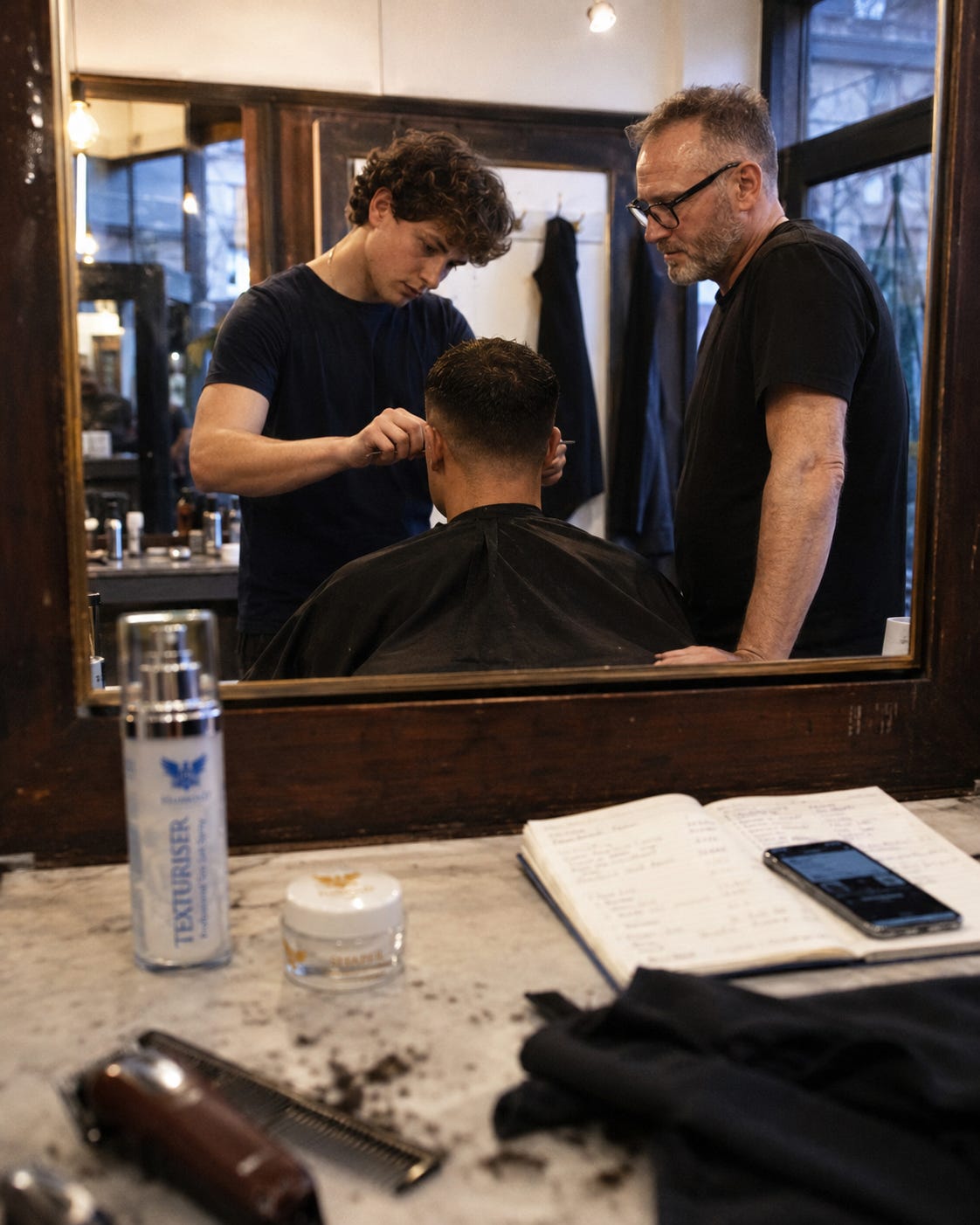
Some of the sharpest people I have ever met stand behind a chair.
They do not always speak like consultants.
They may not have framed degrees on the wall.
Some struggle with paperwork, spelling or sitting still through meetings that should have been an email.
That does not make them stupid.
It means their intelligence often works where it matters.
In the real world.
With real people.
Under pressure.
The old stereotype about hairdressers and barbers is tired.
That they were not academic.
That they fell into the trade because they could not do anything else.
That they just cut hair, sweep floors and ask where you are going on holiday.
Rubbish.
The best hairdressers and barbers are observers, psychologists, problem-solvers, diplomats and entrepreneurs.
The chair is their classroom.
Thousands of customers are their education.
No gown. No ceremony. Plenty of loose hair down the back.
They read people better than most
A great barber starts reading the customer before they sit down.
Do they want conversation?
Do they want silence?
Are they nervous?
Are they embarrassed about thinning hair?
Are they pretending not to care?
Are they hiding behind a joke?
Has somebody ruined their last haircut?
Has their relationship ended?
Have they got a job interview?
Are they trying to become a different version of themselves?
Sometimes the customer asks for a haircut.
Sometimes they are asking for confidence.
The best professionals know the difference.
They notice the teenager staring at the floor.
The regular who normally talks but suddenly says very little.
The man asking for the same haircut he had at twenty, despite his hair having made other arrangements.
They notice when customers start leaving three weeks between appointments instead of two.
That tells you more about the economy than half the people on television.
This is emotional intelligence in its purest form.
It is earned one conversation at a time.
You cannot teach it in a seminar.
You cannot download it from a leadership podcast.
You learn it by paying attention.
By adjusting in real time.
By knowing when to speak.
When to listen.
When to make somebody laugh.
And when to keep your mouth shut.
That last one remains an advanced qualification.
The chair becomes a confessional
People tell their barber or hairdresser things they do not tell their friends.
Sometimes they do not tell their family.
Relationship breakdowns.
Business struggles.
Health scares.
Money problems.
New babies.
Affairs.
Loneliness.
Bereavement.
Fresh starts.
You hear the full story of somebody’s life between the consultation and the final mirror check.
The skill is not getting people to talk.
People will talk.
The skill is knowing what to say back.
You are not a therapist.
You should not pretend to be one.
But you can listen without judgement.
You can make somebody feel understood.
You can give them an hour where life feels slightly lighter.
Sometimes that hour carries more weight than they will ever admit.
A customer may remember one quiet sentence from their barber for years.
The barber probably forgot it by closing time.
That is how quietly this trade changes lives.
No press release required.
They understand customers better than corporations
Large companies spend millions trying to understand ordinary people.
They commission surveys.
They build consumer profiles.
They employ consultants to produce eighty-page presentations about why Dave bought a tin of wax.
Meanwhile, the barber down the road already knows.
He sees spending habits change before the accountants do.
He knows when confidence is rising.
He knows when people are playing safe.
He knows what customers will pay for.
He knows what they complain about.
He knows what makes them loyal.
He knows what makes them leave.
A salon owner sees fashion, confidence and money moving in real time.
There is no six-month delay.
The evidence is sitting in the chair.
That knowledge is worth a fortune.
Yet too many people in our industry still undervalue it.
They think they only cut hair.
They do not.
They understand a market from the inside.
Most executives would pay handsomely for that knowledge.
Then explain it back to the trade using a pie chart.
The technical skill is massively underrated
Cutting hair is not just snipping.
Every head is different.
Face shape.
Head shape.
Growth patterns.
Cowlicks.
Density.
Texture.
Damage.
Colour history.
Lifestyle.
Maintenance.
Expectations.
Then the customer produces a filtered photograph of a model with different hair, different bone structure and enough studio lighting to guide aircraft.
You still have to solve the problem.
You must understand what the customer likes about the image.
Explain what is realistic.
Adapt it to the person sitting in front of you.
Then deliver something that works on Monday morning without a film crew.
That takes technical skill.
Creativity.
Judgement.
Diplomacy.
And patience.
Usually while the phone rings, another customer waits and the card machine decides it no longer believes in commerce.
Doing that well for ten hours on a Saturday is not an easy job.
Most people would be hiding in the stockroom by lunchtime pretending to count towels.
Many were failed by traditional education
A lot of brilliant hairdressers and barbers struggled at school.
I did.
Traditional education often has a narrow idea of intelligence.
Sit still.
Write neatly.
Remember information.
Repeat it in the approved format.
Do not interrupt.
Do not question too much.
Some people thrive in that system.
Others do not.
Some people learn by doing.
By creating.
By watching.
By speaking.
By making mistakes and trying again.
They may struggle in a classroom and flourish in a shop full of people.
That is not a lack of intelligence.
It is a different form of it.
The problem is that many people carry the judgement of school into adult life.
They were told they were not clever.
So they become excellent hairdressers but doubt they could open a salon.
They build loyal clienteles but assume they could never create a brand.
They understand customers better than the executives selling products to them, yet still assume the executive is smarter because he owns a suit and says “consumer journey” without laughing.
That belief holds the trade back.
A clientele is proof of entrepreneurship
Building a loyal clientele is real business.
You attract customers.
You earn trust.
You solve problems.
You deliver consistently.
You handle complaints.
You protect your reputation.
You keep people coming back.
That is entrepreneurship.
A clientele is the first business a hairdresser or barber builds.
Every returning customer is proof that you can create value.
One good haircut proves very little.
You have to do it again.
Then again.
Then again.
You have to deliver when you are tired.
When the shop is busy.
When the customer is awkward.
When life outside work is difficult.
That repetition builds trust.
Trust builds loyalty.
Loyalty builds a business.
The next step is taking the same standards used to build the clientele and applying them to everything else.
The shop.
The team.
The finances.
The systems.
The culture.
The products.
Too many talented people build an outstanding clientele and then surround it with an average business.
The haircuts are excellent.
The accounts are a crime scene.
The service is personal.
The systems exist mainly inside the owner’s head.
The appointment book is full, but the whole operation collapses if one person takes a week off.
That is not freedom.
It is a demanding job with your name above the door.
Some could run a dozen shops
Some of the barbers and hairdressers I know are so capable that, given time, structure and confidence, they could run a dozen successful shops.
They already understand the hardest part.
They know how to build trust.
They know how a good shop should feel.
They know when standards are slipping.
They know how to create an atmosphere people want to return to.
They understand the system because they have lived inside it.
But running twelve shops is not the same as personally running twelve chairs.
You cannot grow by trying to do everything yourself.
You grow by passing your standards on.
One brilliant barber can build one brilliant chair.
A disciplined entrepreneur can turn that standard into a team.
Then a shop.
Then several shops.
But only when the quality survives without the founder standing beside every customer.
That is the real test.
Not opening another door.
Keeping the standard once it opens.
Standards are everything
A great shop is not defined by expensive mirrors.
Or fashionable chairs.
Or a neon sign saying something profound about fades.
It is defined by standards.
How customers are greeted.
How consultations are handled.
How clean the shop is.
How staff speak to people.
How the work is checked.
How complaints are resolved.
How products are recommended.
How the last customer on Saturday is treated with the same care as the first customer on Tuesday.
Those standards are the real business.
The furniture can be copied.
The branding can be copied.
The colour scheme can be copied.
Discipline is harder to copy.
Standards must live inside the people.
Standards cannot be taught quickly
You cannot teach standards in one meeting.
You cannot build pride through a two-hour induction.
You cannot hand somebody a manual and expect them to understand every small decision that creates an excellent customer experience.
Standards need long-term investment.
They need training.
Correction.
Supervision.
Patience.
Repetition.
They need thousands of reps.
A young barber does not become excellent because somebody showed them a technique once.
They become excellent by repeating it.
Making mistakes.
Receiving honest feedback.
Correcting those mistakes.
Then doing it again.
The same applies to service.
Leadership.
Retail.
Management.
Judgement cannot be rushed.
Culture cannot be downloaded.
Pride cannot be installed overnight.
The owner must repeat the message long after they are tired of hearing themselves say it.
They must defend the standard when the shop is busy.
When staff are tired.
When money is tight.
When nobody appears to be watching.
That is discipline.
Not control for the sake of control.
Discipline protects the customer.
It protects the team.
It protects the reputation everyone depends on.
Passing on standards is the real skill
The best entrepreneur is not simply the person who delivers outstanding work.
It is the person who teaches somebody else to deliver it.
Then teaches future leaders to protect it.
That requires humility.
You must stop believing nobody can do it as well as you.
You must explain the things you currently do through instinct.
You must turn personal habits into repeatable systems.
You must correct people without destroying their confidence.
You must invest in them before they become fully productive.
Some will leave after you train them.
That hurts.
But refusing to train people because they might leave guarantees that the business stays small.
The goal is not to create robots.
It is to create professionals who understand why the standard matters.
People who make good decisions when the owner is not there.
That is how one brilliant chair becomes one brilliant shop.
Then two.
Then twelve.
Not through shortcuts.
Through standards, investment and reps.
Talent without discipline is not enough
Emotional intelligence is commercial intelligence.
People return to those they trust.
They pay more when the value is real.
They recommend businesses where they feel understood.
They forgive honest mistakes when the relationship is strong.
That is not soft.
That is commerce.
But warmth alone does not run a business.
A full appointment book does not automatically mean a healthy company.
Too many talented people avoid the numbers.
They underprice.
They overstaff.
They ignore margins.
They spend money making the shop look successful while the bank account quietly files a complaint.
They confuse being busy with being profitable.
That is not entrepreneurship.
That is exhaustion wearing expensive trainers.
The best owners combine people skills with commercial discipline.
Know your costs.
Know your margins.
Know which services make money.
Know which products move.
Know what your time is worth.
Know when to invest.
Know when to say no.
Creativity opens the door.
Discipline keeps the lights on.
Hairbond was built behind the chair
Hairbond does not just want to sell products.
We want to work with the ambitious barbers, hairdressers and salon owners raising standards across the industry.
The people building loyal clienteles.
Training teams.
Creating better shops.
Taking pride in their work.
Trying to make next year better than the last.
Hairbond was built behind the chair.
We understand the trust a professional earns.
We know that a recommendation carries weight because the customer believes the person giving it.
That relationship should never be taken for granted.
Our role is not to tell good barbers how to run their shops.
They know their customers better than most corporations ever will.
Our role is to support their ambition.
With dependable products.
Fair margins.
Real education.
Visibility.
Honest conversations.
And long-term partnerships that respect the professional instead of using them to create demand and then stealing the final sale online.
We want to work with people who see their shop as more than somewhere customers attend an appointment.
It can be a serious business.
A local institution.
A training ground.
A brand.
A platform for products, education and opportunity.
The exciting people in this industry are not waiting to be rescued by a multinational.
They are building their own world.
Hairbond wants to build alongside them.
Never underestimate the person holding the scissors
Hairdressers and barbers are observant.
Creative.
Resilient.
Diplomatic.
Commercial.
Emotionally intelligent.
Many already have the drive and skills to build something far bigger than one chair.
They do not need to become somebody else.
They need to recognise the value of what they already know.
Build the craft.
Build the clientele.
Build the standards.
Pass those standards on.
Then build the business strong enough to carry them forward.
The scissors are where the journey starts.
They do not have to be where it ends.