


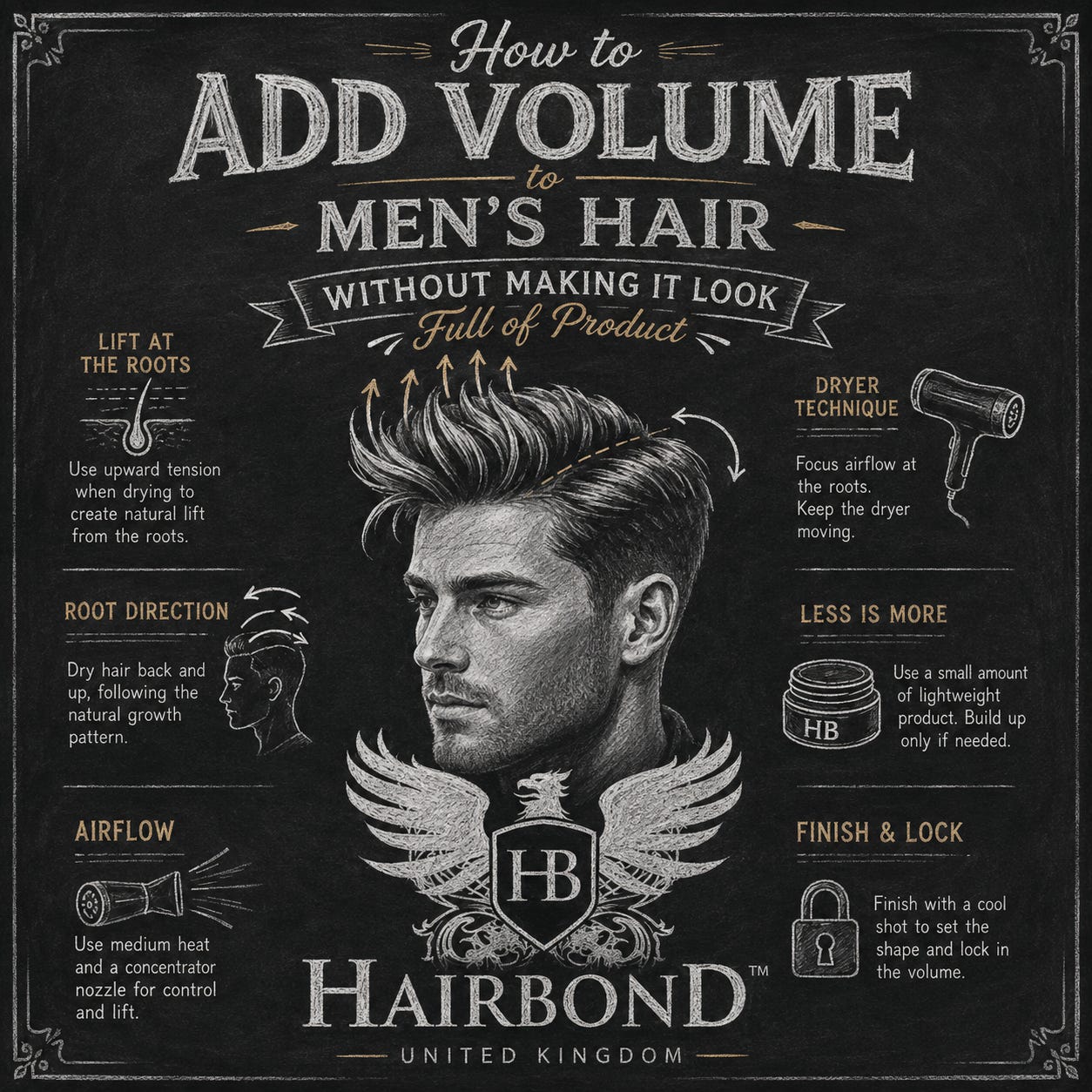
Men have an interesting solution to flat hair.
Add product.
Still flat.
Add more.
Still flat.
Eventually there is enough wax on the head to seal a conservatory.
The hair remains flat.
That is because volume and hold are not the same thing.
Hold keeps hair where you put it.
Volume is the space the hair occupies.
You can have huge hold and almost no volume.
You can also create serious volume with very little finishing product.
The trick is understanding the haircut, the root, the airflow and the weight of whatever you put on afterwards.
Hairbond has worked around professional hair since 2008.
The lesson is simple:
The jar comes last.
What volume actually means
Volume is not more hair.
It is more space between the hair and the scalp.
Take the same number of hairs.
Lay them flat.
Very little volume.
Lift them away from the scalp.
Separate them.
Give them direction.
Suddenly the hair looks fuller.
No new follicles.
No miracle ingredient.
Just better architecture.
Volume, density and thickness are different things
These words get mixed together constantly.
Hair thickness refers to the diameter of individual strands.
Hair density is how many hairs are growing in an area.
Volume is how much visible space those hairs occupy once styled.
A styling product cannot manufacture new follicles.
It cannot turn naturally fine hair into coarse hair.
But it can help the hair you already have sit higher, separate better and look fuller.
That is a realistic promise.
Realistic promises tend to age better.
Why hair goes flat
Before fixing flat hair, work out what is flattening it.
Fine hair
Fine strands bend easily.
That makes them particularly vulnerable to heavy waxes, oils and too much finishing product.
Thick hair
The opposite problem.
There may simply be too much weight.
If the haircut carries excessive bulk, gravity eventually wins.
Long hair
More length means more weight.
You can still create volume.
You just need more intelligent cutting and better drying.
Oily roots
Sebum makes individual strands group together.
Grouped hair occupies less visual space.
Fine hair shows this particularly quickly.
Product build-up
Yesterday’s product.
Today’s product.
Dry shampoo.
Conditioner.
More finishing product.
Eventually the hair is carrying luggage.
Bad weight distribution
Sometimes the haircut is the problem.
No spray fixes poor geometry.
That conversation belongs with the barber or hairdresser.
The haircut comes first
If you want volume, say so before the cutting starts.
The person cutting your hair needs to consider:
Density
Strand thickness
Length
Internal weight
Crown
Hairline
Growth direction
Head shape
A good haircut creates room for the hair to move.
A poor one sends you home with a tub and a prayer.
Fine hair: be careful with thinning scissors
Fine hair can benefit from texture.
But texture does not mean mindlessly removing density.
If already-fine hair is aggressively thinned, you can end up with exactly what nobody requested:
less hair.
The aim is to create movement while preserving enough structure for the hair to support itself.
Removing weight and removing useful density are not the same thing.
A good cutter knows the difference.
Thick hair: remove weight intelligently
Thick hair can collapse because there is simply too much of it.
Here internal weight reduction can help.
But this is a haircut job.
Not something a hairdryer can “strip out”.
The dryer can lift and redirect what remains.
The scissors determine how much remains.
Important distinction.
Your scalp and crown are part of the styling system
Most product guides talk as though hair grows straight upward from a flat sheet of plastic.
It does not.
Your crown affects direction.
Your hairline affects where volume looks natural.
Your head shape affects silhouette.
Your scalp affects how quickly the roots become oily.
Some crowns spiral cleanly.
Some double back on themselves.
Some appear determined to start a separate business.
Work with the growth pattern where possible.
Trying to force a stubborn crown in the opposite direction can produce impressive volume for twelve minutes.
Then nature resumes management.
The hairdryer is the real volume product
This is the part men skip.
Then they blame the clay.
A hairdryer gives you something finishing product cannot easily create afterwards:
root direction.
When damp hair is heated and held away from the scalp, you can establish lift before applying anything heavy.
Then the finishing product only has to maintain the shape.
Much easier.
The dryer builds it.
The product signs it off.
Stop using the hairdryer without the nozzle
That narrow attachment in the box is not packaging.
It is a concentrator nozzle.
Without one, air spreads in multiple directions.
You lift one section.
The loose airflow blows the next one down.
Progress becomes a small domestic argument.
A concentrator focuses the airflow.
That allows you to direct heat more precisely at the section and root you are trying to lift.
For volume, point the nozzle along the direction you want the hair to travel rather than blasting the entire head like you are drying a wet dog.
More control.
Less chaos.
Which brush should you use?
The brush matters.
Not because you need a £90 object made from moon dust.
Because different shapes do different jobs.
Vent or skeleton brush
Best for:
Short hair
Crops
Textured tops
Fine hair
Fast root lift
The open structure allows air to move through the brush and reach the hair around the roots.
Lift the section.
Direct the concentrator through it.
Simple.
Small round brush
Best for:
Quiffs
Pompadours
Longer fringes
Maximum front lift
A round brush creates tension and curvature.
Pull the hair upward and slightly back while following with the dryer.
That creates much stronger shape than pointing a dryer at the forehead and hoping.
Ceramic round brushes can retain heat, so do not cook the same section indefinitely.
Hair is styling material.
Not toast.
Fingers
Underrated.
Excellent for:
Messy texture
Fine or thinning hair
Natural movement
Short fringes
Finger drying creates lift without forcing every hair into the same polished direction.
Sometimes that is exactly what you want.
The correct blow-dry technique
Start with damp, not soaking hair.
Then:
1. Decide where you want the volume
Front?
Crown?
Fringe?
Whole top?
Have a plan.
2. Lift at the root
Volume begins at the scalp.
Use fingers or your brush to pull the root away from the head.
3. Dry against the natural direction
For extra lift, temporarily dry the hair opposite to the direction it will eventually sit.
Then redirect it.
That gives the root more movement.
4. Use controlled airflow
Concentrator on.
Section by section.
Do not blast everything simultaneously.
5. Stop flattening it with your hands
Men do this beautifully.
Build volume.
Then smooth both palms over it.
Volume gone.
Achievement unlocked.
Use fingertips.
6. Cool the shape
Once the hair is where you want it, allow it to cool.
A cool-shot function can help set the shape.
Do not immediately squash it while it is still warm.
Heat matters
More heat does not automatically mean better hair.
Use enough to dry and shape.
Not enough to roast the scalp.
Fine, fragile or thinning hair usually needs less aggressive heat than very thick hair.
Keep the dryer moving.
Avoid holding concentrated high heat on one area for long periods.
Professional styling is controlled heat.
Not punishment.
What temperature should you wash your hair with?
Use lukewarm water.
Extremely hot water can leave the scalp and hair feeling dry or irritated.
That does not mean your sebaceous glands immediately panic and manufacture three gallons of oil.
Human biology is rarely that theatrical.
The useful routine is simpler:
Wash the scalp properly.
Rinse thoroughly.
Avoid excessively hot water.
Then style from a clean foundation.
A cooler final rinse is perfectly fine if you like how it feels, but you do not need mythology about “closing pores” or magically switching off oil glands.
Clean roots help volume.
That is enough.
Oil and volume
Sebum itself is not bad.
It protects the scalp and hair.
But when enough oil reaches fine roots, strands begin sticking together.
That reduces visible volume.
If your hair is flat by lunchtime, look at:
How oily your scalp naturally is
Whether shampoo is being rinsed properly
Conditioner placement
Product build-up
Styling product quantity
How often your hair actually needs washing
Do not blindly follow somebody else’s shampoo schedule.
Your scalp was not consulted.
Conditioner: use it where needed
Conditioner can make hair easier to manage.
It can also make fine roots too soft if a rich formula is heavily applied near the scalp.
If you have fine, straight hair, concentrate conditioner mainly through the lengths and ends.
Rinse properly.
If your hair consistently collapses after conditioning, adjust the product or quantity.
You are conditioning hair.
Not marinating it.
What pre-styler should you use?
Lead with function.
Not branding.
Sea-salt or texturising spray
Useful for:
Grip
Separation
Fine hair
Crops
Messy fringes
Curtains
It gives soft hair more resistance.
Hairbond makes a Texturiser Sea Salt Spray in this category.
So do many professional brands.
The category is what matters.
Lightweight primer
Useful for:
Manageability
Blow-drying
Smoothing
Frizz control
Preparing thicker or more unruly hair
Hairbond’s Wonder Professional Hair Primer is one example.
Again:
Choose the job first.
Then the bottle.
Sea salt spray is not seawater in a fancy bottle
The purpose is grip.
Soft, slippery hair often collapses because strands slide past one another too easily.
A texturising spray gives them more friction.
That can make lift easier to create and maintain.
Do not soak the hair.
A few controlled sprays.
Work through.
Dry.
You are styling.
Not launching a lifeboat.
Finishing products: choose by weight
This is where most volume gets murdered.
You have built beautiful lift.
Then apply something far too heavy.
Gone.
Choose the lightest finishing category that gives enough control.
Root powder
Very light.
Very dry.
Excellent for fine roots and quick lift.
Use sparingly.
Matte clay
Good for:
Texture
Separation
Crops
Short-to-medium styles
A professional matte clay such as Hairbond Distorter is one example.
The point is the dry finish and manageable weight.
Fibre
Useful where you need:
Stronger structure
Grip
More control
Shape that needs to last
Hairbond’s Super Fibre sits here.
Super came partly from a very practical problem: finer, receding hair needed structure without being buried under heavy styling product.
That story matters because it explains the brief.
Not because every fine-haired man automatically needs Super.
Paste
Often sits between cream and clay.
Useful where you want control but still want movement.
Cream
Best where softness and flexibility matter more than big hold.
Particularly useful on waves, curls and longer hair.
Do not put heavy finishing product straight onto fine roots
Roots create the lift.
If you cover them in heavy wax, you add weight at exactly the point that needs freedom.
With heavier finishers:
Focus mainly on the mid-lengths and ends.
Then use whatever remains on your fingertips where extra control is required.
Dry powders are different.
They are specifically designed to create friction around the root area.
Different product.
Different job.
How much product?
Start small.
Pea-sized is a useful starting point for many short styles.
Not a law.
A starting point.
Warm the product properly.
Spread it over both hands.
Apply evenly.
Then inspect the result.
Need more?
Add more.
Most men do not destroy a hairstyle by using 8% too little product.
They destroy it by using three times too much.
Volume for fine hair
Fine hair needs:
Root lift.
Grip.
Low weight.
The routine:
Clean, damp hair.
Light texturising spray.
Concentrator nozzle.
Vent brush or fingers.
Dry roots against their natural direction.
Redirect into the finished shape.
Cool.
Add a very small amount of matte product if needed.
Notice how late the jar appears.
That is not an accident.
Volume for thick hair
Thick hair needs:
Correct cutting.
Weight control.
Strong root direction.
If too much internal weight remains, speak to the barber.
Once the haircut is right:
Use sections.
Lift with a vent or round brush.
Use the concentrator.
Dry the roots properly.
Then finish with a matte paste, fibre or clay depending on the style.
Do not pile strong product onto undried thick hair.
You are adding weight to a weight problem.
Volume for thinning or receding hair
The objective is not enormous height.
Usually it is better density perception.
That means:
Keep useful length
Avoid over-thinning
Create moderate lift
Keep strands separated
Avoid excessive shine
Avoid excessive product
Use fingers or gentle brush tension.
You do not need to yank fine hair around a ceramic brush like you are trying to start a lawnmower.
Low-to-moderate heat.
Controlled airflow.
Light finish.
Hairbond Super Fibre or Distorter may suit some hairstyles here, but so may a good lightweight powder.
Match the product to the result.
Volume for curls
Curly hair already creates space.
Do not wreck it.
Use a diffuser.
Low airflow.
Moderate heat.
Cup the curls from underneath.
Let the diffuser support them as they dry.
A lightweight curl cream or primer can provide control.
Avoid blasting curls with concentrated high-speed air.
That often turns defined curl into enthusiastic weather.
Volume for a quiff
Now we need more engineering.
Start damp.
Add a lightweight pre-styler.
Use a small round brush.
Lift the front upward.
Create tension.
Follow the brush with the concentrator.
Roll slightly back.
Cool.
Then finish with a fibre, paste or clay.
If you build the quiff properly with heat, finishing product becomes insurance.
Not scaffolding.
Volume for curtains
The key area is the parting.
If the roots lie flat there, the whole haircut hangs.
Dry the hair in the opposite direction first.
Then establish the centre part and redirect both sides.
This creates lift near the root.
Keep the finishing product light.
Curtains need movement.
Otherwise you have installed shutters.
Volume for textured crops
You do not need huge height.
You need:
Lift.
Separation.
Broken texture.
Sea-salt or texturising spray.
Vent brush or fingers.
Dry forward and slightly upward.
Finish with a little matte clay or paste.
Stop before every strand looks individually represented by legal counsel.
The Hairbond perspective
Hairbond makes products.
So it would be very easy for us to tell you the answer to every problem is another Hairbond product.
It isn’t.
Sometimes you need a better haircut.
Sometimes you need a nozzle.
Sometimes you need a £10 brush.
Sometimes you simply need to use half as much product.
That is more useful advice.
And in the long run, useful advice sells professional products better than pretending every styling problem begins with an empty shopping basket.
The Hairbond range at Hairbond.com covers different functions:
Texture.
Grip.
Preparation.
Structure.
Control.
Finish.
The point is not to use all of them.
The point is to understand which job needs doing.
Five rules for better volume
1. Start with the haircut.
Bad weight distribution beats good product.
2. Lift the roots.
That is where volume begins.
3. Control the airflow.
Use the nozzle.
It came in the box for a reason.
4. Use the right tool.
Vent brush for fast lift.
Round brush for tension and shape.
Diffuser for curls.
Fingers when natural movement matters.
5. Finish lightly.
Product should preserve the work.
Not sit on top of it.
The final rule
Men’s styling spent years obsessed with stronger hold.
Strong hold.
Extreme hold.
Twenty-four-hour hold.
Enough hold to survive re-entry.
But hold is only useful if the hair looked good before you froze it there.
For volume:
Cut it properly.
Wash it sensibly.
Lift the root.
Direct the air.
Use the right brush.
Let the shape cool.
Then add the smallest amount of finishing product that does the job.
That is the difference between styling hair and simply putting stuff in it.
Hairbond has been making the stuff since 2008.
We still think the technique comes first.
That should tell you something.