
Football has always sold haircuts.
Long before influencers stood in bathrooms pointing at discount codes like they had discovered fire, lads were walking into barbershops with a picture of a footballer on their phone.
Beckham did it.
Ronaldo did it.
Grealish did it.
Now the World Cup does it again.
A player walks down the tunnel. The camera catches the trim. Somewhere, five minutes later, a lad is sat in a barber chair saying, “Can you do that?”
The barber looks at his hairline, takes a breath, and says, “We can do our version.”
That is barber language for no.
But that is the power of football.
It moves shirts.
It moves boots.
It moves songs.
It moves haircuts.
And if I am honest, that is part of the reason Hairbond exists.
This is why I am starting this Substack.
Not to write polished little grooming tips that sound like they were approved by a committee in a glass office.
This will be about Hairbond history. Football influence. Barber culture. Product creation. Retail survival. Trends that matter. Trends that need putting in the bin with the thinning scissors nobody admits to using.
Because Hairbond was not built in a boardroom.
It was built from behind a chair.
I was a hairdresser. I owned a salon. I still cut hair. I have stood behind thousands of men who wanted more than a haircut, even if they would never say it out loud.
Men do not walk into a barbershop and say, “I would like confidence, please.”
They say, “Just a tidy up.”
Then they watch every single hair hit the floor like it is evidence in court.
A good haircut can change a man’s week.
The right product can make that haircut last longer than the walk home.
That is the bit people miss.
The haircut gets the attention.
The product keeps the promise.
Over the years, Hairbond has always had a connection with football. Not in the fake corporate way. Not through a shiny agency deck full of words like activation, synergy and consumer touchpoint.
Once you hear those words, you know someone has never swept hair from under a barber chair in their life.
I mean real connections.
Players.
Barbers.
Dressing rooms.
Messages.
Favours.
Trust.
Word of mouth.
The old way. The proper way.
More than a decade ago, we did a shoot with Belgium goalkeeper Simon Mignolet in the Cavern.
I still remember what that meant.
Hairbond was not some giant brand with a multinational machine behind it. It was a British product with roots in barbering, trying to earn its place. Then suddenly there we were, doing a shoot with a Belgium international goalkeeper.
It felt mad.
This little brand from Lancaster had found its way into football.
Not through a supermarket buyer.
Not through a celebrity agent.
Not through a committee of people wearing lanyards.
Through relationships.
Through players.
Through barbers.
Through the simple fact that the product worked.
That has always mattered to me.
Because football dressing rooms are not polite product-testing labs. Players do not care about your brand story if the product leaves their hair looking like a wet pigeon. They use what works. Then their mates ask. Then the barber asks. Then the product travels.
That is how Hairbond moved.
Patrick Forster has worked with Newcastle and Sunderland players. That matters. Football in the North East is not soft. You cannot bluff it there. The haircut has to hold. The product has to perform. The barber has to trust what is in his hand.
If it does not work, you will not get a marketing report.
You will get a look.
And every barber knows that look.
Equinox in Southampton has had the same thing with their players. The players come in. The styles move. The products get seen. Lads ask questions. The barber uses what he trusts.
That is the chain.
That is the real influence.
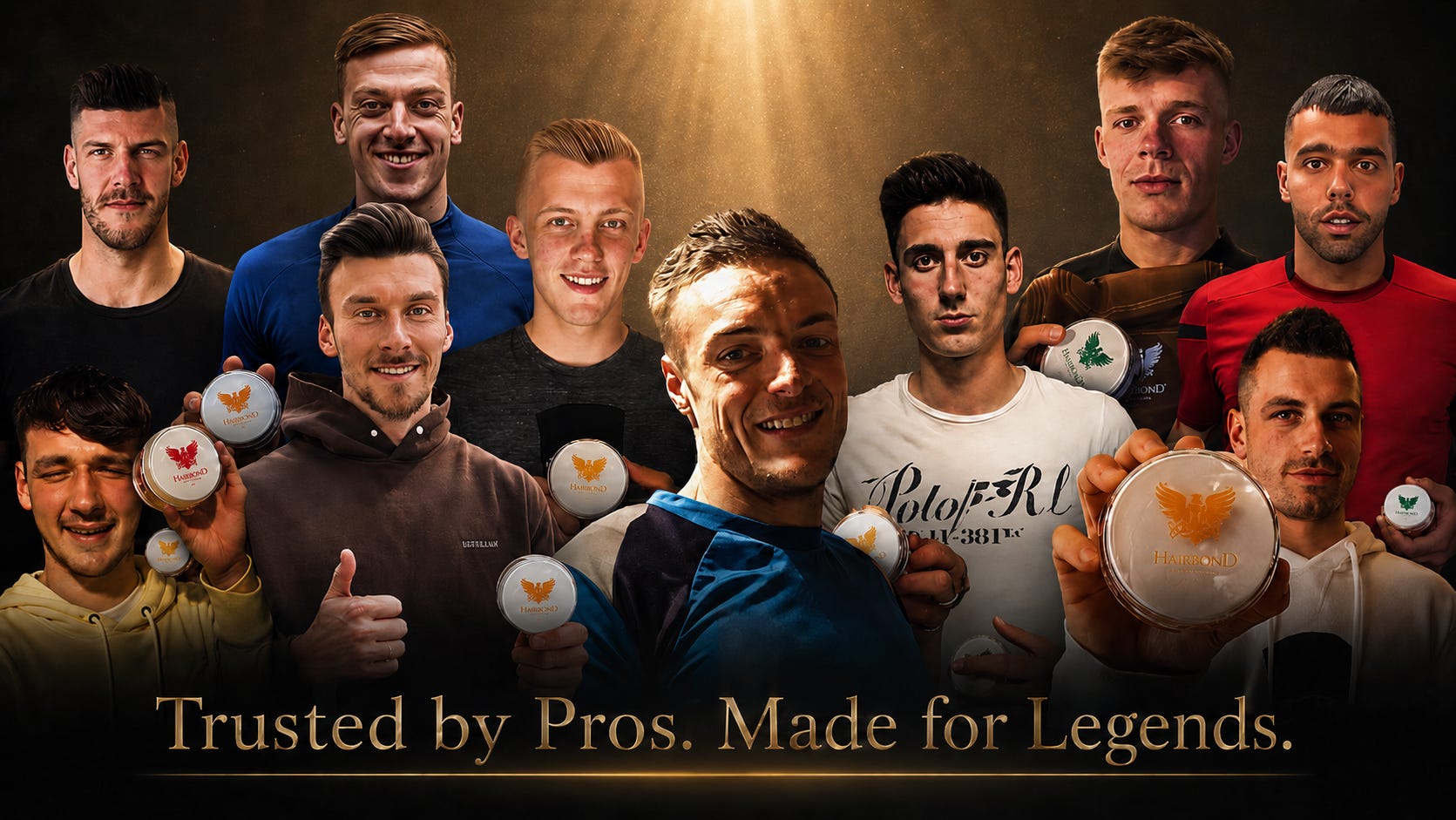
Paul Gallagher helped me get Hairbond in front of players like Jamie Vardy and Jordan Pickford. Again, that did not come from some polished corporate pitch. It came from football. From trust. From people knowing people.
That is how small brands grow when they do not have a bottomless cheque book.
And even now, players still reach out on social media. Some are known. Some are coming through. Some just like the product.
That is how it should be.
Not everyone needs to be paid to pretend.
That is a dangerous sentence in modern marketing, I know. Someone at a big agency has probably just dropped their oat latte.
But it is true.
The best endorsement is still the one that happens when nobody is watching.
At this World Cup, the haircut I keep noticing is Kevin De Bruyne’s.
Not because it is wild. Not because it is screaming for attention. It does the opposite.
It is clean. Grown-up. Controlled.
A proper footballer haircut.
It says he has enough going on in his head without needing fireworks on top of it.
That is why I like it.
No nonsense.
No panic.
No “I found myself in Ibiza and came back with a mullet.”
Just a strong, grown man’s haircut.
In a world full of filters, fake confidence and lads asking for a skin fade when their head shape says please reconsider, that stands out.
But I want to know what other people think.
Who has the best haircut at the World Cup?
Is it De Bruyne?
Is it the sharp fade?
The long hair?
The textured crop?
The curls?
The player nobody is talking about yet?
Because this is where football and barbering meet.
A haircut does not become a trend because a magazine says so.
It becomes a trend when lads walk into barbershops on a Saturday morning and say, “Can you do this?”
That is the real market research.
Not a focus group.
A barber chair.
And the barber is the honest one in the room.
He knows when your hair can do it.
He knows when your hair cannot do it.
He knows when you have brought in a photo of a 23-year-old Champions League winger and you are carrying the raw materials of a tired accountant after a long tax year.
That is not cruelty.
That is service.
Barbers have always been the real scouts of grooming. They know what players use before brands do. They know what lads ask for before magazines do. They know what sells because they have to look the customer in the eye after using it.
That is why Hairbond has stayed close to barbers.
Barbers are not just people who cut hair.
They are independent retailers.
They are local businesses.
They are taste makers.
They are the last proper line between real grooming and supermarket sludge.
And yes, I said it.
Supermarket sludge.
Because small brands like Hairbond do not just compete against other hair products. We compete against multinational machines.
They have the shelf space.
They have the ad budgets.
They have the buying teams.
They have the power to discount a product until the soul falls out of it.
That is what people do not see.
A big company can afford to lose money on a line if it helps them own a category. A small brand cannot play that game. We have to survive on quality, loyalty, margin and reputation.
No shortcuts.
No giant safety net.
No marketing department turning failure into a “learning phase.”
Just stock, cash flow, product, barbers, customers and the constant fight to stay standing.
That is why discounting damages brands.
It trains the customer to wait.
It punishes the barber.
It kills the independent retailer.
It makes everything feel cheap.
And when everything feels cheap, only the biggest survive.
That is not competition.
That is a slow corporate strangling with a loyalty card.
Hairbond is still here because we refused to sell the brand’s soul for a quick order. We did not build it to be tossed into a bargain bin with a red sticker slapped across it.
What would a designer say if someone took a Tom Ford suit and stuck a big red discount cross over the front?
They would call it vandalism.
But in grooming, people act like small brands should be grateful for any shelf.
No.
A good brand needs the right shelf.
A proper product needs the right hands.
That is why barbers matter.
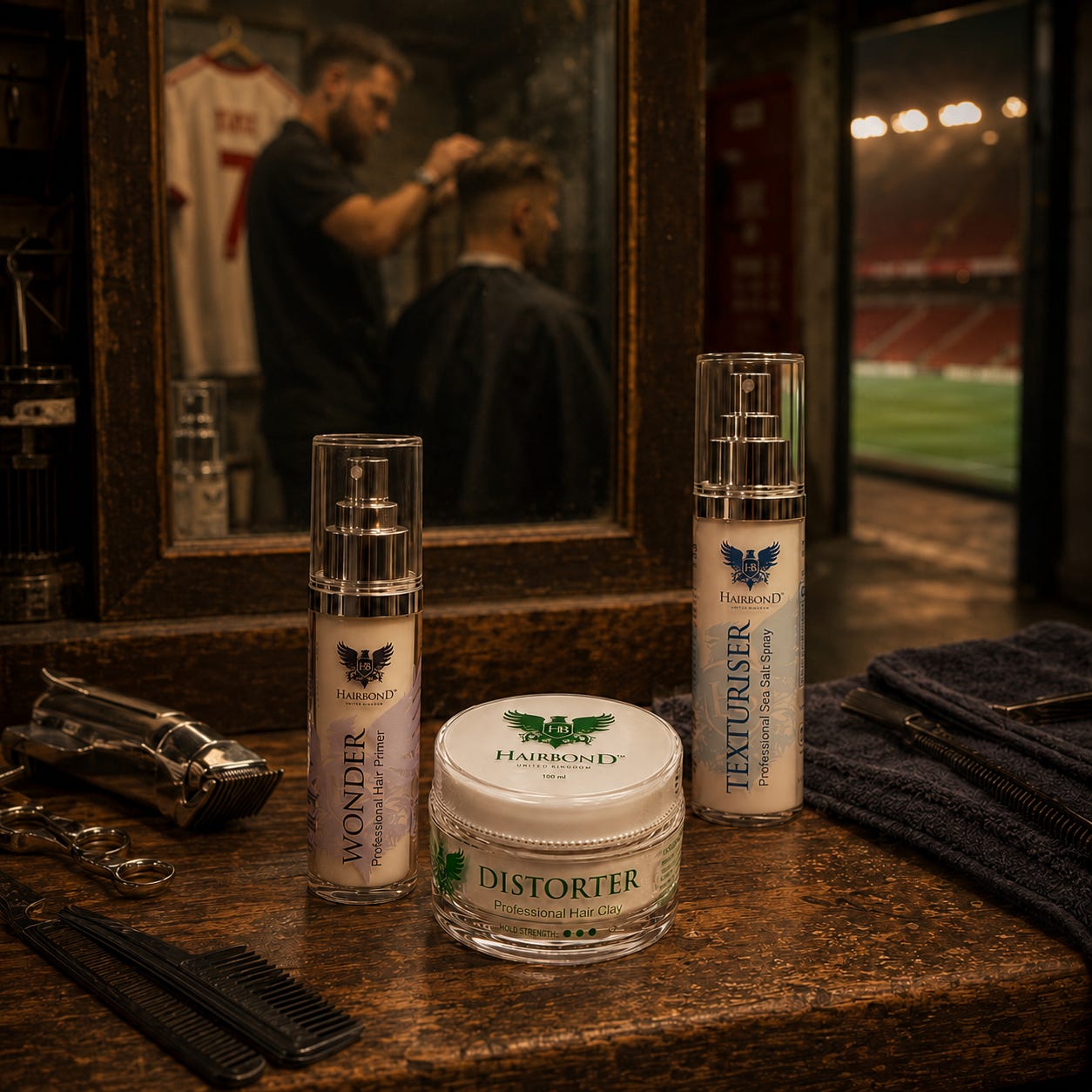
When a barber stocks Hairbond, he is doing more than selling a jar. He is keeping retail independent. He is backing product performance over corporate muscle. He is giving the customer something with a story, not just a barcode.
That is what I want this Substack to stand for.
I will write about how we created products.
Why texture matters.
Why fragrance matters.
Why hold is not the same as helmet head.
Why matte products changed men’s hair.
Why some products sell once and others build a customer for years.
I will write about the barbers who helped build Hairbond.
I will write about the players, the shoots, the near misses, the wins, the graft and the reality of trying to keep a British grooming brand alive when the market is dominated by giants with deeper pockets and colder hands.
Because Hairbond was never built by a committee.
It was built in salons.
It was worn by lads.
It was backed by barbers.
It found its way into football dressing rooms one relationship at a time.
That still matters.
Maybe it matters more now.
So tell me.
Who has the best haircut at the World Cup?
And when you next buy a product from your barber, remember this.
You are not just buying wax, clay or spray.
You are voting for the kind of industry you want to survive.
If you want to try the products, visit Hairbond.com and see what we have built the hard way. If you are a barber, salon or independent retailer who still believes good products belong in proper hands, visit partners.hairbond.com and stock Hairbond direct. Because every jar sold through an independent chair helps keep the game alive. Not just the haircut. The industry behind it.