


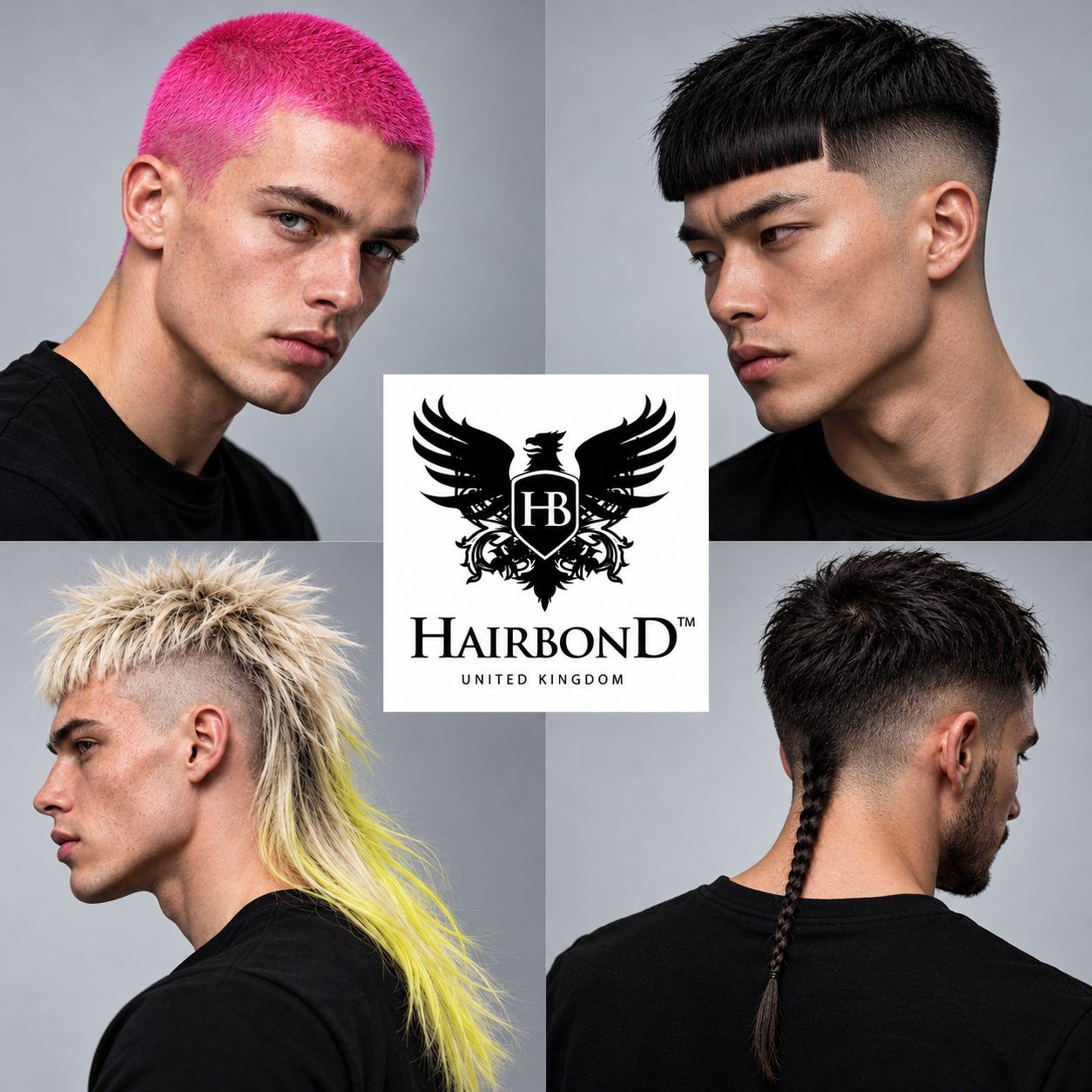
The client has a photograph. You have the scissors.
Between the two sits the most important part of the appointment: understanding what they actually want.
A tiny fringe. A fluorescent buzz. A sharp disconnection. A longer tail emerging from an otherwise restrained cut.
At Hairbond, our forecast for the adventurous end of men’s hair in 2027 is about those details gaining ground. We expect more clients to borrow one striking feature from an extreme look and make it part of their everyday identity.
For barbers and hairdressers, preparation starts with understanding the references, assessing the hair and choosing a finish that supports the design.
Fashion labels amplify the direction
Hair is part of a fashion collection’s identity. Its texture, proportion and movement help communicate the character of the clothes.
Vogue’s coverage of the spring 2027 men’s shows highlighted Guido Palau’s angular punk cuts and small braided tails for Prada. Earlier, GQ’s report from Rick Owens’ autumn 2026 show documented experimental “skullets,” with unconventional fringes, shaved sections and coloured tails.
Those shows provide visible references for the direction we are watching. They do not establish how many clients will request it.
Fashion houses have the reach to circulate these ideas through runway photography, backstage films and editorial coverage. Our view is that repeated exposure can make an initially unfamiliar detail feel increasingly wearable.
The influence also travels in several directions. Music, football, street style and subcultures feed fashion, which can amplify a look without having invented it.
Professionals should watch the session hairstylists as closely as the labels. Look across collections for recurring changes in fringe length, weight distribution, surface texture and silhouette.
One dramatic image is inspiration. A repeated idea deserves closer attention.
The coloured buzz: the colour service is the commitment
The coloured buzz is our strongest candidate for wider adoption among the bolder looks. Heist of London’s forecast moving into 2027 includes versions ranging from bleached blonde to pink.
The visual impact is immediate. The technical work deserves equal attention.
Begin with scalp condition, previous chemical services, existing colour and the intended maintenance routine. A close cut exposes the hairline, scalp and head shape, so agree the length before treating the colour photograph as a complete brief.
Porosity matters even on short hair. As Wella’s professional toning guidance explains, highly porous hair can take up colour too quickly and become over-toned. Previously lightened areas therefore need assessment before further processing.
Use a lightener approved for the intended application, carry out the tests required by the chosen system and follow its instructions. For on-scalp work, use a compatible scalp protector where the manufacturer recommends it; a barrier product cannot make an unsuitable service safe. Wella’s scalp-care guidance discusses professional scalp primers as one part of that preparation.
Agree toner maintenance, colour-appropriate cleansing and regrowth appointments before the client leaves.
Consultation focus: assess scalp visibility and hairline shape across all textures. A buzz may suit someone seeking simplicity in daily styling, while a vivid or platinum finish can still require substantial colour maintenance.
Hairbond finish: a very close buzz may need no styling product. As it gains enough length for separation, Distorter Clay is a starting point for a flexible matte finish.
The geometric crop: preserve the weight that creates the shape
The geometric crop makes the outline the statement. Prada’s spring 2027 work offers a reference for strong angularity; the salon interpretation might be a blunt fringe, a square corner or one deliberately disconnected panel.
Before cutting, examine the natural fall, crown movement and density around the temples. Decide where weight must remain to support the perimeter.
Over-texturising can undermine the very outline the client wants. Check the balance around the parietal ridge, where the sides transition into the top, and assess the profile throughout the service.
Consultation focus: straighter or loosely wavy hair can provide a starting point for a crisp outline. On finer or lower-density hair, preserve sufficient weight; on curlier hair, design the geometry around the natural pattern and expected shrinkage. Adapt fringe depth to the hairline.
Hairbond finish: choose Forger Putty when the design needs strong matte control, particularly through thicker, more resistant hair. Forger’s published hold factor is 5/5. Choose Distorter Clay when flexible matte separation is the priority.
Forger is currently listed for preorder; check availability when planning stock.
The turbo mullet: balance the crown, profile and nape
Rick Owens’ experimental autumn 2026 hair and the fluorescent Dior mullets described in GQ’s report are references for the more radical end of this direction.
Our forecast is that selected details will travel further than the complete runway versions: a shorter fringe, more pronounced disconnection or extra length at the nape.
Treat the mullet as a full silhouette. Consider crown growth, weight behind the ears and how the retained length falls below the occipital bone at the back of the head.
The longest section alone does not define a successful result. The relationship between the top, sides and back does.
Consultation focus: waves and curls can contribute movement through the nape; straighter hair may reveal the cut’s geometry more clearly. Where density is limited, retain useful weight and avoid creating transparent ends. Agree the profile as carefully as the front view.
Hairbond finish: Super Fibre is a starting point for a dry, lifted top needing structure. Drifter Crème, with a 2/5 hold factor, suits longer sections that should retain softness and movement. Vector Gum, rated 3/5, offers definition with natural shine.
Apply by section. The crown and nape may need different finishes.
The braided tail: make the detail intentional
Prada’s spring 2027 braided tails show how one narrow section can change the character of an otherwise familiar cut.
For a client, that offers a concentrated point of difference. Its success depends on placement, available length and how it relates to the surrounding silhouette.
Consultation focus: establish whether the selected section has enough length and density to braid without excessive tension. Consider how the detail will look loose, braided and grown out. Discuss maintenance before committing to the placement.
Hairbond finish: use Distorter for matte texture through the surrounding crop, or Vector where a more defined, naturally shiny finish is wanted. Wonder Primer can help prepare longer hair for styling.
Braiding technique and suitable fastening provide security. Keep finishing product focused on the result it can contribute.
The warrior cut: texture with a wearable route in
The warrior cut offers a less dramatic entry into this direction. British GQ’s interviews with practising barbers describe a messy, heavily textured shape associated with Brad Pitt’s hair in Fight Club.
It is a useful reference for clients seeking more attitude through separation and movement.
Consultation focus: the interviewed barbers particularly identify straight hair as a useful starting point and note challenges with very fine or tightly coiled hair. Adapt the amount of layering to the density. Discuss height and width against the client’s features instead of imposing a fixed face-shape rule.
Hairbond finish: Texturiser Sea Salt Spray provides a starting point for grip and volume during preparation. Finish with Super Fibre for stronger dry structure or Distorter Clay for more flexible matte separation.
Why layering works—and why the order matters
A pre-styler and a finishing product perform different jobs.
As L’Oréal Professionnel explains in its overview of hair bonds, hydrogen bonds contribute to temporary shape changes and are affected by water and heat. Wetting and controlled drying allow hair to be reshaped temporarily.
Sea salt spray should not be described as the agent that “breaks hydrogen bonds.” In the Hairbond styling approach, Texturiser’s role is to help establish grip, texture and volume while the drying technique establishes direction.
Once the shape is in place, the finishing product adjusts separation, control and surface finish.
That is the logic behind Texturiser followed by Super: build a textured foundation, then add structure. For a softer result, use Distorter as the finishing choice.
Where preparation and a relaxed finish are the priorities, Wonder followed by Drifter is another starting point. Wonder followed by Vector suits a finish requiring more definition and natural shine. These combinations follow the roles described in the Hairbond Cocktail Bar.
Forger’s published formulation description identifies clays, waxes and binding polymers as contributors to its texture and control. Ingredient names alone, however, cannot predict how a finished product will behave in every client’s hair.
Start with a small amount and assess the result before adding more. On porous, lightened hair, account for condition before pursuing a very dry finish.
The quick professional reference
For preparation and manageability, start with Wonder. For grip and a textured foundation, consider Texturiser.
For flexible matte separation, choose Distorter. For dry volume and stronger structure, consider Super. For strong matte control through a deliberate shape, look to Forger.
For softer longer lengths, choose Drifter. For definition and natural shine, consider Vector. For firm, pliable shaping, Shaper Toffee remains another option.
These are starting points. Texture, density, length, condition and the intended finish determine the final choice.
Prepare the team, then prepare the client
Runway-to-salon interpretation is already part of professional forecasting. After working on Maximilian Raynor’s spring/summer 2027 show, Blue Tit London’s Tom Warr identified looks he expected to reach salons.
Turn that awareness into practical preparation. Build a reference collection with front, side and back views across different textures. Practise unfamiliar cutting, colour and braiding techniques before offering them as a service.
During consultation, establish which feature the client wants, how it will behave between appointments and what they will need to do at home. Quote the complete service, including specialist work and finishing time.
Then demonstrate the routine. Show the quantity, placement and drying direction, and let the client try part of it.
At Hairbond, we expect the opportunity in extreme hair for 2027 to come from making bold ideas personal and achievable. The professional brings the judgement; the product supports the finish.
Read the direction. Design for the individual. Teach the finish.
Explore Hairbond’s professional range or visit Hairbond Partners for trade enquiries.