

I’ve spent most of my working life around hair.
And barbers have always had their own uniform.
Nobody designed it. Nobody wrote the rules.
It just happened.
Black T shirts. Sweatshirts. Hoodies. Denim. Boots. Trainers. Workwear. Streetwear. Tattoos. Jewellery. Vintage pieces.
Walk into a great barbershop in London, Manchester, Liverpool, New York or Barcelona and you’ll see completely different people connected by something familiar.
Individuality.
Barbers don’t need a shirt and tie to prove they’re professionals.
Their work does that.
That’s where Hairbond Barber Division starts.
Not with fashion.
With barber culture.
Professional Doesn’t Mean Corporate
There was a time when looking professional meant dressing like you worked in an office.
Shirt. Tie. Polished shoes.
Barbering was never really that world.
A barber works with their hands. They’re on their feet for hours. They’re dealing with people all day.
You’re part craftsperson, part stylist, part listener, part business owner and occasionally part therapist.
You remember who wants a skin fade and who definitely doesn’t.
You know the customer who says “same as last time” even though last time was six weeks ago.
You know when somebody wants to talk.
You know when they don’t.
And you know the difference between somebody leaving your chair satisfied and somebody leaving feeling ten feet tall.
That’s professionalism.
Nobody needs a tie to prove it.
The clothes should reflect the job and the people doing it.
Not Barber Merch
This was important from the beginning.
I didn’t want to make barber merchandise.
There is enough of that already.
Put some scissors on a black T shirt.
Add a barber pole.
Write BARBER across the back.
Finished.
That’s not what I wanted.
I want somebody to see a Hairbond Barber Division piece and think:
That’s a great piece of clothing.
Then they look closer.
The references reveal themselves.
The chair.
The pole.
The razor.
British heritage.
The characters.
The humour.
The darkness.
The pride in the craft.
Hairbond.
Not merchandise for barbers. Clothes made with barbers in mind.
There’s a difference.
Barbering Has Its Own Culture
The barbershop isn’t just somewhere you clock in.
The music matters.
The chairs matter.
The walls matter.
The pictures matter.
The people matter.
Even the smell of the place matters.
A great shop develops its own personality.
So do the people working inside it.
Barber culture takes influence from everywhere.
Music. Football. Tattoo culture. Streetwear. Workwear. Vintage Americana. British subcultures. Motorcycles. Art. Fashion.
Then it mixes everything together.
That’s why two barbers can both be dressed entirely in black and still look completely different.
There isn’t one barber look.
There is an attitude.
That’s what interests me.
Built Behind the Chair
One of the first ideas I came up with was:
BUILT BEHIND THE CHAIR.
Because that’s exactly what happens.
You don’t become a great barber because you bought expensive clippers or put BARBER in your Instagram bio.
You build it.
One haircut at a time.
You remember those early cuts that took forever.
The mistakes.
The awkward silences.
The first customer who specifically asked for you.
The Saturdays when you barely sat down.
The late finishes.
The customers who disappeared.
The ones who stayed.
The ones who became mates.
Then something changes.
People aren’t simply walking into the shop anymore.
They’re coming to see you.
You’ve built a clientele.
You’ve built trust.
You’ve built a reputation.
You’ve built a living.
And you built most of it standing behind a chair.
That’s why Built Behind the Chair belongs on the clothing.
It isn’t just a slogan.
It’s recognition.
The Designs Have to Tell the Story
The artwork isn’t decoration added to a sweatshirt afterwards.
The artwork is part of the idea.
Look closely and almost everything means something.
The barber chair sits at the centre because that’s where the culture begins.
It’s the workplace.
The stage.
The place where thousands of conversations happen.
And for many barbers, it’s where they built their business.
The barber pole connects everything back to the history of the trade.
The razor represents the craft.
Then we take those traditional references somewhere else.
Bigger.
Darker.
Louder.
More Hairbond.
The Lion and the Empty Chair
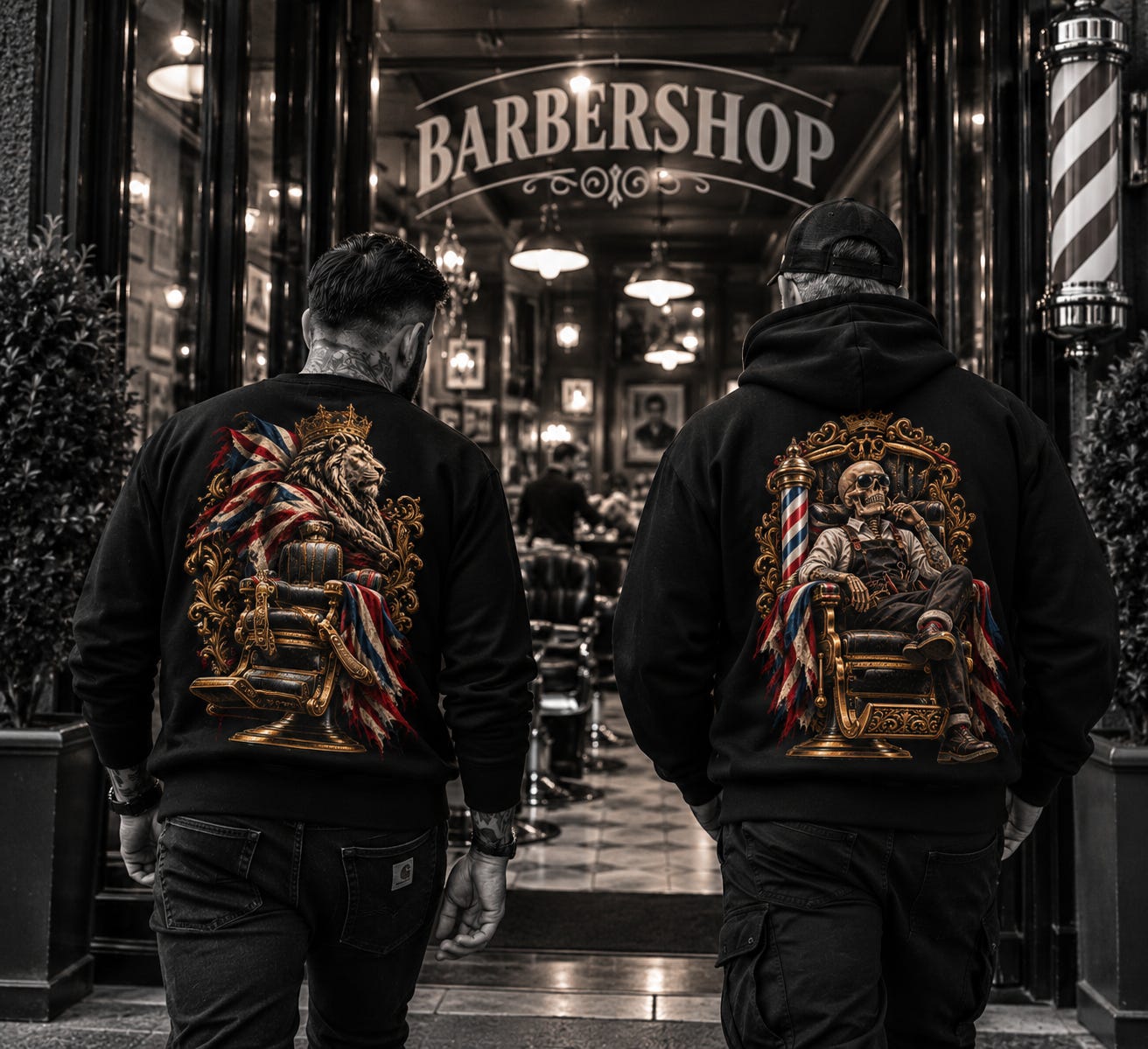
One of the first designs puts a crowned British lion above an old barber chair.
Around it are distressed Union Jacks, gold detailing, crowns and the Hairbond Barber Division identity.
The lion represents confidence and Hairbond’s British roots.
But I particularly like the empty chair.
Because the barber isn’t there.
The chair belongs to whoever earned it.
The person wearing the piece completes the design.
That idea gets right to the heart of Barber Division.
The clothing isn’t supposed to create your identity.
You’ve already built that yourself.
The Barber Who Never Left
Then there’s Built Behind the Chair.
A skeleton barber sits back in an ornate chair.
Sunglasses on.
Boots up.
Tattoos.
Tools around him.
Barber pole beside him.
There’s humour in it.
But there’s something else underneath it.
The skeleton looks like he’s become part of the chair.
Anyone who has spent years barbering will understand that.
Thousands of haircuts.
Thousands of conversations.
People getting jobs.
People losing jobs.
People getting married.
People getting divorced.
Kids growing up.
Customers becoming friends.
Good news.
Bad news.
Life happening in front of the mirror while you’re standing behind it.
Then the customer leaves.
The next person sits down.
And you start again.
Years pass like that.
That’s what the skeleton represents to me.
Not death.
Time served.
British, But Not Polite
The Union Jack runs through some of the first designs because Hairbond was born in Britain.
But I didn’t want a perfect flag.
That wouldn’t feel right.
Ours is battered.
Torn.
Weathered.
The gold is oversized.
The crowns are excessive.
The chairs look more like thrones.
There’s a bit of punk in it.
A bit of tattoo art.
A bit of rock and roll.
A bit of old British grandeur dragged through a barbershop.
British, but not polite.
That feels much closer to Hairbond.
McQueen, Plein and the Barbershop
I’ve always liked designers who aren’t frightened of identity.
Alexander McQueen could take British heritage and make it dark, rebellious and beautiful.
Philipp Plein comes from a completely different direction, but understands spectacle.
Sometimes clothing doesn’t have to whisper.
I like that attitude.
But they are influences, not templates.
I’m not interested in creating a Hairbond version of somebody else’s clothes.
Because the most important influence isn’t a fashion house.
It’s the barbershop.
Tattoo flash.
Old barber poles.
Leather chairs.
Gold mirrors.
Black workwear.
Football.
Music.
Boots.
British subcultures.
The characters who have spent their lives working behind the chair.
Put those influences together and you start getting something that looks like Hairbond Barber Division.
Some People Will Hate Them
Good.
I don’t want every design to appeal to everybody.
One barber will look at the crowned lion and want it immediately.
Another will want something much quieter.
Someone else will choose the skeleton.
That’s how it should be.
Personal style is personal.
If everybody likes every design, we’re probably playing too safe.
That’s also why Barber Division won’t become one enormous permanent catalogue.
We’re creating small collections and limited edition designs.
Some will be loud.
Some will be minimal.
Some may evolve.
Some might only appear once.
And when they’re gone, they’re gone.
Limited Edition. Made to Order.
The pieces are made to order.
You choose one.
Then it’s made for you.
That changes what we’re able to create.
We don’t need to manufacture thousands of identical T shirts and fill a warehouse before discovering whether anybody actually wanted them.
We can create something because we believe in it.
Release it.
See who connects with it.
Then move forward.
It means less unnecessary stock.
But creatively, it gives us something even more valuable.
Freedom.
Freedom to experiment.
Freedom to make something strange.
Freedom to make something that won’t appeal to everybody.
Freedom to release smaller collections without needing to turn every idea into a mass market product.
And because these are limited editions, I want there to come a point when somebody sees one of the early Barber Division pieces and asks:
“Where did you get that?”
And the answer might genuinely be:
“You can’t anymore.”
That’s what limited should mean.
The Clothes Are the Canvas
The simplest way I can explain Barber Division is this:
The clothes are the canvas.
A great black T shirt.
A heavyweight sweatshirt.
A hoodie.
A bomber jacket.
Then the culture goes on the back.
I deliberately like the major artwork there.
From the front, you’re wearing a great black piece.
Turn around and suddenly there’s the story.
A crowned lion.
An empty barber’s throne.
A skeleton who looks like he’s been behind the chair forever.
Gold.
Flags.
Razors.
Barber poles.
Hairbond.
You don’t have to explain that you’re part of barber culture.
The clothes do it for you.
Clothes You Can Actually Work In
They still have to work.
These aren’t costumes.
A barber bends.
Reaches.
Sweeps.
Washes hair.
Makes coffee.
Answers the phone.
Cuts another head.
Then another.
Then another.
So the clothes need to make sense behind the chair.
But they also need to make sense when you leave it.
You should be able to work in a Hairbond sweatshirt all day, go for a pint afterwards and never feel like you’re still wearing your uniform.
That’s the test.
If it only makes sense inside a barbershop, we’ve got it wrong.
Hairbond Isn’t Becoming a Fashion Brand
This is the most important part.
Hairbond isn’t suddenly pretending to be a fashion house.
We’re a professional hair brand.
We’ve been around since 2008.
Our world is hair.
Our world is the chair.
And the people around Hairbond already have their own culture.
Barber Division is simply holding up a mirror to it.
We’re not here to tell barbers what’s fashionable this season.
I’d rather look at what they’re already wearing.
What music they’re playing.
What boots they’re buying.
What artwork they’re putting on the walls.
What shops they’re building.
What influences them.
What makes them laugh.
What they actually want to wear for ten hours behind the chair and still want to wear when they leave.
Then we create from there.
A Mirror for Barber Culture
Barbering has changed enormously since Hairbond started in 2008.
The shops got sharper.
The photography got better.
Social media created barber personalities.
Independent shops became serious brands.
Barbers became educators, creators, entrepreneurs and business owners.
But the thing at the centre hasn’t changed.
A chair.
A barber.
A customer.
A conversation.
A haircut.
Then somebody looking in the mirror when it’s finished.
That’s the world Hairbond came from.
It’s the world Barber Division is being designed for.
Not fashion for fashion’s sake.
Not corporate uniform.
Not generic merchandise.
And definitely not a shirt and tie.
Hairbond Barber Division isn’t a fashion brand.
It’s a mirror.
A reflection of the people behind the chair.
Their humour.
Their pride.
Their individuality.
The clothes they wear.
The music they listen to.
The shops they build.
The culture they’ve created.
We’re not here to tell barbers how to dress.
We’re making clothes that understand why they already dress the way they do.
The First Collection Is Live
The first Hairbond Barber Division pieces are available now.
T shirts. Sweatshirts. Hoodies. Jackets.
Small collections. Limited edition designs. Made to order.
Designed around the people who spend their working lives making everybody else look better.
If you’re behind the chair, this was made with you in mind.
SHOP THE HAIRBOND COLLECTION →
HAIRBOND® BARBER DIVISION
EST. 2008 · UNITED KINGDOM
LIMITED EDITION · MADE TO ORDER · BUILT BEHIND THE CHAIR.