


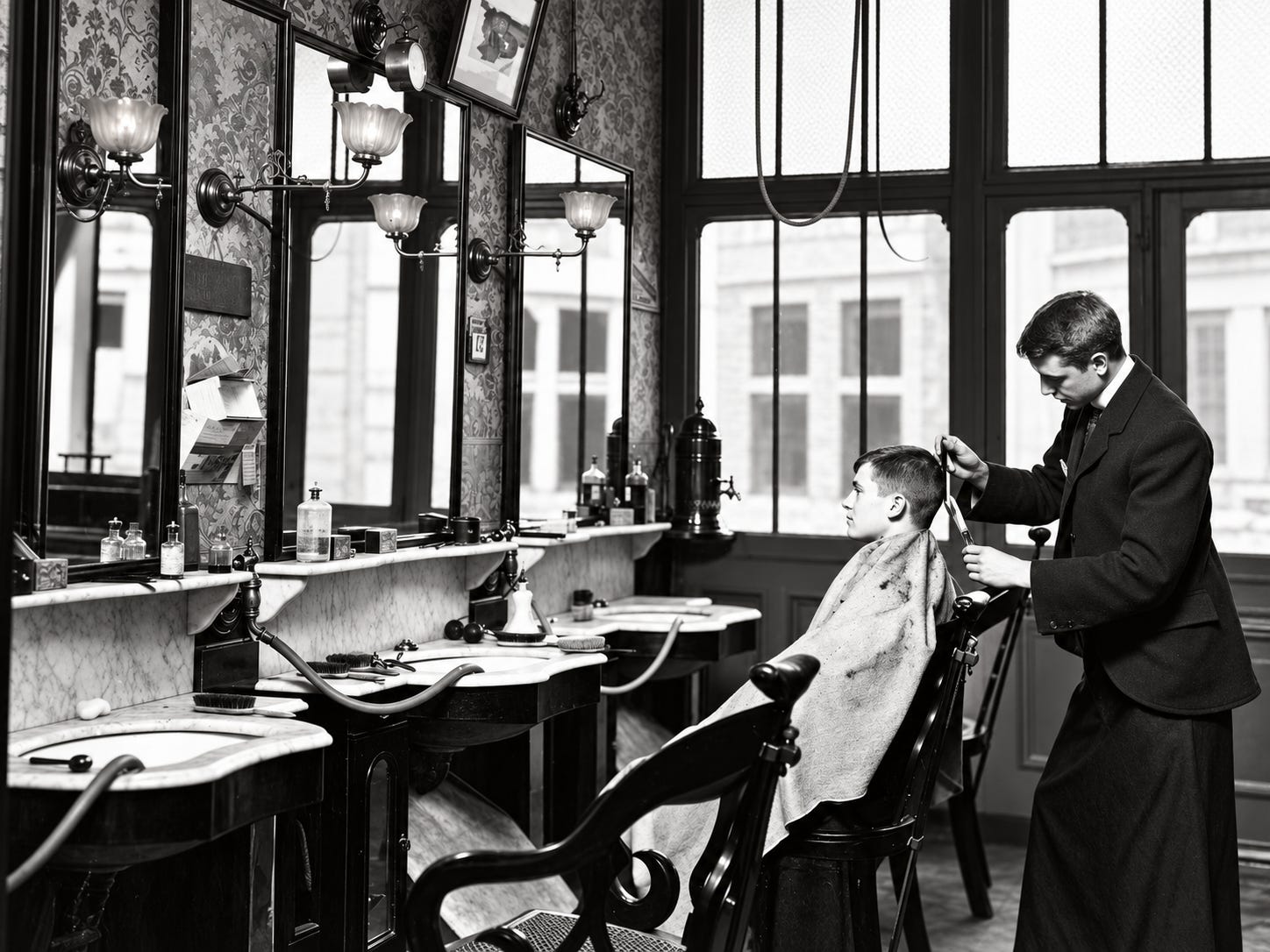
When I left school at fifteen, I didn’t have an academic future mapped out for me. I needed somebody willing to give me a chance, and hairdressing provided one.
By nineteen, I owned a salon.
That opportunity changed my life. Not because somebody handed me a business, but because experienced people invested their time in teaching me something useful.
They gave me a trade.
And there’s something troubling happening in British hairdressing today.
We’re producing an industry of independent professionals while making it increasingly difficult for the people responsible for training them to survive.
Everybody wants a good hairdresser.
But who’s paying to produce one?
We’re Eating Our Own Future
The National Hair & Beauty Federation’s autumn 2025 research revealed that 43% of surveyed businesses had reduced their apprentice numbers over the preceding three months.
That’s not a minor administrative problem.
It’s a warning about the future supply of skilled people.
We have thousands of barbers and hairdressers working independently. Chair rentals, small studios, self-employed professionals and single-chair businesses are now an established part of the British high street.
And I support that independence.
If you’ve developed your skills, built your clientele and want to work for yourself, good luck to you.
But the industry’s changing structure leaves a question nobody can afford to ignore.
Where will the next generation learn?
An established salon can spend years developing somebody who eventually leaves to rent a chair down the road.
That’s their right.
But the salon still paid for the supervision, the mistakes, the quieter appointment book and the hours spent developing that person’s ability.
The new independent professional enters the market carrying the skills that somebody else helped pay to create.
Multiply that across an industry and you begin to see the problem.
The businesses doing the training carry a cost from which the entire profession eventually benefits.
That’s not a reason to discourage independence.
It’s a reason to rethink who funds the training.
The Numbers Behind the Chair
Let’s look at what an apprentice costs.
Since April 2026, the statutory apprentice minimum wage has been £8 an hour for eligible apprentices.
At 35 paid hours a week, that’s £280 in wages.
Over 52 weeks, it comes to £14,560.
That’s before allowing for workplace pension obligations where applicable, equipment, consumables, supervision and the time an experienced stylist spends teaching rather than serving paying customers.
Eligible apprentices under 25 already attract employer National Insurance relief on earnings up to the relevant threshold.
So the issue isn’t that government provides no support.
It’s that removing one employment tax doesn’t eliminate the actual cost of training.
Now imagine an experienced stylist spends five hours a week supervising an apprentice.
Suppose those hours would otherwise generate £40 an hour in salon revenue.
That’s £200 a week of potential sales capacity being redirected into training.
Across 46 working weeks, it’s £9,200.
It’s an illustration, not an industry average. Some supervision takes place during normal service work and doesn’t displace all that revenue.
But it demonstrates something important.
The real cost of an apprentice isn’t just the wage.
It’s the resources needed to turn a beginner into a professional.
And the person paying those costs is often the small employer with the least financial flexibility.
Now compare that with somebody renting a chair.
They may pay a fixed amount for their space, manage their own clients and operate without employing anybody.
It’s a perfectly legitimate business model when structured correctly.
But the training obligations are different.
One business is developing tomorrow’s workforce.
The other may be working entirely with skills developed yesterday.
Both can contribute to the industry.
They simply aren’t carrying the same responsibilities.
We Need to Reward the People Who Teach
Here’s where I’d start changing things.
Government already provides apprenticeship support, including National Insurance relief and funding for eligible training.
In September 2026, ministers also outlined additional hiring payments for qualifying young apprentices.
Those measures matter.
But if apprenticeship numbers continue to decline, clearly the existing structure needs further examination.
Rather than proposing another broad tax exemption, I’d introduce a reward for employers who retain and successfully develop apprentices.
A payment linked to genuine training milestones.
One when the apprentice completes an agreed period of employment.
Another when they achieve occupational competence.
The money should support the business providing the training, without punishing apprentices who legitimately move elsewhere.
And the process must be simple enough for somebody running a three-chair salon to understand without hiring an accountant to complete the paperwork.
We need to reward results.
Not simply registrations.
Why Can’t Five Barbershops Train One Apprentice?
Here’s another idea.
Imagine five independent salons in the same town.
None can justify taking on a full-time apprentice alone.
But together they could support a structured local training partnership.
Each provides supervised experience, perhaps specialising in different techniques.
A recognised training provider coordinates the programme.
One experienced professional oversees assessment and progression.
The apprentice gets exposure to several working environments rather than learning every technique from one person.
It would need properly structured employment contracts, safeguarding, insurance, wage arrangements and a clear accountable employer.
That’s important. Training cannot become an excuse for casually shifting young workers between businesses.
But shared apprenticeship models exist in other sectors.
Why shouldn’t we investigate properly regulated versions for hairdressing and barbering?
We keep treating the independent salon as an isolated business.
Perhaps the future requires greater cooperation between businesses that would otherwise never employ an apprentice.
The Manufacturers Should Put Something Back
This is where I believe the professional hair care industry has a responsibility.
Manufacturers, distributors and product houses depend on working hairdressers.
Without the people behind the chair, there is no professional market.
Yet the relationship too often revolves around purchasing stock, opening accounts and meeting sales targets.
I’d like to see more manufacturers investing directly in the development of the people who will use their products for the next thirty years.
Fund apprentice toolkits.
Support independent training providers.
Pay experienced professionals to mentor students.
Offer small grants to businesses taking on their first apprentice.
And publish the results.
Not another competition where somebody wins a trophy.
Actual training.
Real skills.
Young people finding employment.
I’ve built Hairbond since 2008, and I know what goes into running a professional hair care brand.
I also know where that business came from.
The trade.
If manufacturers benefit from a skilled workforce, we should be prepared to contribute to creating one.
That includes me.
A Qualification Should Be the Beginning
We need to stop confusing passing an assessment with becoming an accomplished professional.
Qualifications matter.
Standards matter.
But the most important lessons often arrive when things go wrong.
A customer whose hair behaves differently from anything you’ve practised on.
A complaint you have to resolve.
A busy Saturday when every appointment runs late.
An experienced stylist showing you how to fix a mistake without losing the customer’s confidence.
That’s the education I remember.
I’d like colleges and training providers to work more closely with commercial salons, with meaningful supervised client experience and realistic workplace expectations.
Students should learn how appointments make money, what affects client retention and why a profitable business is more valuable than simply looking busy.
But let’s be careful about introducing blanket mandatory hours that small employers cannot accommodate.
The standard should be demonstrated competence.
Not time served for the sake of filling in a form.
And we shouldn’t teach every young barber that the ultimate ambition is to open their own shop.
Some of the finest people in this profession have spent their entire working lives as employees.
They deserve proper careers, progression and financial rewards without being pushed towards business ownership.
The Test I’d Set the Industry
Rather than another conference where everybody agrees something needs doing, I’d like to see a proper trial.
Pick a town.
Bring together ten independent salons and barbershops, a local training provider, interested manufacturers and an apprenticeship funding partner.
Agree a small number of apprenticeship places.
Share the mentoring responsibilities under one compliant arrangement.
Provide the tools.
Help the employers with the supervision costs.
Then measure what happens over two years.
How many young people complete?
How many remain employed in the trade?
How much does training actually cost?
How many participating salons would take another apprentice?
And how do those results compare with traditional apprenticeship arrangements?
Publish the figures, including the failures.
If it works, expand it.
If it doesn’t, change it.
That’s how you build something useful.
Not another glossy report destined to spend its life in somebody’s inbox.
The Door That Opened for Me
I sometimes wonder what would have happened if I had walked into a salon at fifteen and been told there was no money to train me.
Perhaps I’d have found another trade.
Perhaps somebody else would have taken the chance.
I don’t know.
What I do know is that hairdressing provided the foundation for everything I subsequently built.
It taught me how to deal with people, take responsibility, earn trust and eventually run a business.
Nobody could have predicted that a teenager starting out in a salon would eventually build a professional hair care brand.
That’s the beauty of giving young people an opportunity.
You never know what they might become.
But opportunity costs somebody something.
Time.
Money.
Patience.
Experience.
For years, we relied on established salons to provide all four.
Now those businesses are under pressure, and too many of us are looking the other way.
The government should make training financially worthwhile.
Colleges should prepare students for the reality of commercial life.
Manufacturers should help fund the professionals their businesses depend upon.
Experienced barbers and hairdressers should be recognised for passing on their knowledge.
And young people entering the trade should understand that independence means a great deal more when you’ve properly learned your craft.
None of this requires us to turn back the clock.
It requires us to accept that the industry has changed and that the responsibility for developing talent must change with it.
I was fifteen when somebody opened the door for me.
I walked through it and built a life.
The least we can do is make sure somebody is still standing there to open it for the next kid.
Scott Michaels
Founder, Hairbond.